
作者:LING Jialiang 发布时间:2026-01-26 16:27:17 来源:Fudan University+收藏本文
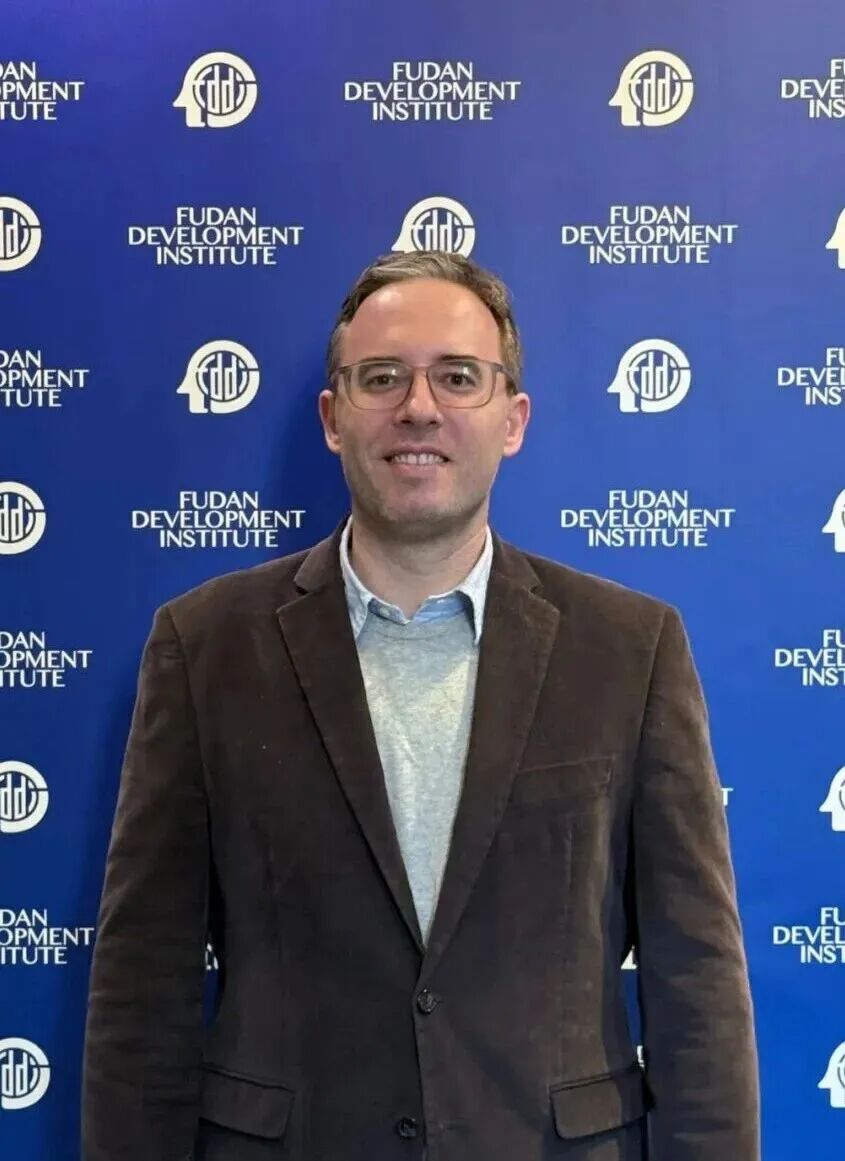
巴西利亚大学国际关系副教授、国际关系硕博项目协调员,《巴西国际政治期刊》(RBPI)主编哈罗尔多·拉曼齐尼·儒尼奥尔(Haroldo Ramanzini Junior)于2025年12月5日至2026年1月3日在我院从事访问研究工作。Ramanzini副教授的研究兴趣包括巴西外交政策、外交政策分析、金砖国家(BRICS)研究以及区域主义,其成果发表于多家学术期刊。
访学期间,Ramanzini副教授的研究考察了巴西如何在不断变化的全球秩序中驾驭地区主义和全球南方合作,将拉美一体化的长期宪法承诺与维持地区治理、贸易和日益政治分裂下的和平区的实际挑战联系起来。在其对南美机构和金砖国家的研究中,他强调合作框架如何扩大对话空间,减少全球治理中的不对称,并帮助全球南方国家在不复制旧等级制度的情况下进行改革。
近日,Ramanzini副教授接受复旦大学融媒体专访,分享其核心研究发现与访学感悟,以下为采访全文:
“The pursuit of autonomy is a cornerstone of Brazilian foreign policy. Brazil does not wish to be subordinate to any country,” said Professor Haroldo Ramanzini Júnior,a visiting scholar at Fudan Development Institute (FDDI) and an Associate Professor at the Institute of International Relations of the University of Brasília.
Ramanzini’s work examines how Brazil navigates regionalism and Global South cooperation amid a shifting global order—linking long-standing constitutional commitments to Latin American integration with the practical challenges of sustaining regional governance, trade, and a “zone of peace” under growing political fragmentation. Across his research on South American institutions and on BRICS, he emphasizes how cooperation frameworks can widen room for dialogue, reduce asymmetries in global governance, and help countries in the Global South pursue reform without reproducing old hierarchies.
Q: Your work spans Brazilian foreign policy analysis, regionalism, and Global South cooperation. Many of your projects engage the concept of “regionalism”. What does regionalism mean in practice for Brazil today?
Ramanzini: Latin American integration is a Constitutional directive in Brazil, which means it is a fundamental guide to Brazilian Foreign Policy. This is one reason why Brazil has been committed for decades - with varying levels of emphasis - to building platforms for dialogue, cooperation, and integration across Latin America and South America.
In this regard, Brazil’s engagement aims to foster regional governance and stability. It also seeks to deepen regional integration and expand intraregional trade. Equally fundamental is the goal to preserve the region as a zone of peace. In the current context, characterized by the Trump administration's unilateralism and interventionism, I believe these goals have taken on even greater importance.
That is why South American regionalism is essential for Brazil, both politically and economically, as well as for all other countries in the region. Brazil itself is a key destination for part of its neighbors' exports, and there are common regional challenges that require cooperative solutions. Furthermore, regardless of differences between governments, regionalism enables a more balanced dialogue with external powers. The goal is for regional issues to be solved regionally, through regional governance and dialogue.
However, the region has experienced increasing political fragmentation in recent years. This has undeniably strained intergovernmental regional bodies like the Amazon Cooperation Treaty Organization (ACTO), the Southern Common Market (Mercosur), the Community of Latin American and Caribbean States (CELAC), the Union of South American Nations (UNASUR), and the Brasília Consensus.
Nevertheless, these institutions are still important for regional governance. Countries need to invest on diplomatic engagement and cooperation in key common areas such as preserving the region as a zone of peace, physical, energy, and infrastructure networks, critical minerals, trade, health, and fighting transnational crime. In my view, Brazil has remained committed to this agenda, even amidst a challenging regional (and global) context.
Q: You have also written on BRICS and South–South cooperation. Do you see BRICS as a form of regionalism, or as a different kind of arrangement? What is the key logic that holds BRICS together despite its internal diversity?
Ramanzini: I do not view BRICS as a form of regionalism but rather as a group comprising countries with significant roles in their respective regions. I would characterize it as a cooperation mechanism with two main dimensions: an intra-BRICS dimension, focused on deepening cooperation among its members, and an extra-BRICS dimension, centered on reforming global governance. These two dimensions are equally important and mutually reinforcing.
Despite its internal diversity, what unites BRICS is the shared objective of reducing hegemonic and asymmetrical practices within international institutions and global governance. In this sense, BRICS have played a pivotal role in voicing the concerns and priorities of the Global South, as well as in advocating for reforms in global governance — including within the IMF, the World Bank, and the United Nations system, particularly the Security Council — so that their composition and decision-making processes may better reflect the realities of the XXI century. To date, one of the reasons for the group’s success has been its internal equilibrium, in the sense that no country imposes its preferences on the others.
In my perspective, BRICS is fundamentally a reform-oriented actor. Its agenda is both pro-BRICS and pro-Global South. It is not anti-Western, nor is it against any specific country.
Q: Looking ahead 5–10 years, what do you see as the biggest opportunities and challenges for BRICS and South–South cooperation? How do you view China´s role in shaping—or constraining—this cooperation?
Ramanzini: The next 5-10 years will be crucial for BRICS to consolidate its current composition following the 2023 enlargement. I believe this new consolidation phase is essential before considering a new wave of expansion. BRICS must preserve its ability to generate substantive proposals and broaden the space for bilateral dialogue among its members. Another critical aspect in this process is expanding the domestic community of stakeholders engaged with the grouping in member countries, as it is defining specific priorities and advancing cooperation mechanisms directly linked to BRICS and its institutional frameworks such as the New Development Bank (NDB).
Ultimately, BRICS should be understood not only by governments but also by societies, which may look to it for practical solutions and new perspectives. To achieve this, South-South cooperation must not reproduce North-South practices.
Building on the reform-oriented trajectory that I have mentioned before, for the next years, much will depend on how the global geopolitical landscape evolves — and on how receptive major international actors and institutions prove to be to demands for greater representation and effectiveness. In my perspective, these dynamics will largely shape the BRICS’ next steps. They will determine whether the group can continue to operate within a reformist agenda or whether it will be compelled to experiment with - or to broaden - alternatives to traditional mechanisms of global governance.
Thus, at a moment when the global order is marked by uncertainty and instability, expectations surrounding the BRICS (and China) may rise, and the group may continue its efforts to offer meaningful contributions both to its members and to the international community. The current wave of unilateralism by Trump´s government — together with the aggressive use of tariffs and other coercive instruments — may, in fact, end up reinforcing BRICS cohesion and importance for each member and for the stability of the world order.
Q: In the context of China–US strategic competition, how does Brazil currently navigate its relationships with both powers? What would be an ideal strategy for Brazil, and what trade-offs are unavoidable?
Ramanzini: It is important to consider that the pursuit of autonomy is a cornerstone of Brazilian foreign policy. Brazil does not wish to be subordinate to any country. At present, it is a nation determined to defend its own interests, as well as those of South America and the Global South, within the frameworks of multilateralism and international law. Notably, Brazil shares borders with ten countries and maintain peaceful relations with all neighbors for over a hundred and fifty years.
Another central tenet of Brazil's global engagement is the principle of universalism - that is, maintaining relations with all countries, not only with those with which it agrees. Not many countries have such a consistent ability to engage in dialogue. Guided by these principles of autonomy and universalism, Brazil seeks to contribute to a multipolar global order. In this sense, Brazil rejects the notion of a global order based on spheres of influence and automatic alignments.
Brazil sees China as a partner. Brazil and China have been working together to strengthen multilateralism and to promote a multipolar order, based on mutual respect and shared benefits. Trump´s unilateralism weaken multilateralism and amplify global instability and tensions. In the face of U.S. disengagement from multilateral forums, the engagement and collaboration between Brazil and China become even more crucial and necessary for the defense of international institutions.
Furthermore, China has been Brazil's main trading partner since 2009. However, the relationship extends far beyond trade and encompasses political dialogue, cooperation in science and technology, infrastructure, satellites, green energy, digital innovation, and people-to-people exchanges. Currently Brazil considers China a key partner in its ongoing process of neo-industrialization and seeks to adding greater value to its exports to the Chinese market.
Brazil and the United States currently have divergent visions for the international and regional order. Even so, Brazil seeks to keep dialogue channels open with Washington, in part to try to mitigate the destabilizing impact of Trump´s policy in the region and in Brazil. It is important to remember that the bilateral relationship between Brazil and the United States spans over two centuries, marked by various phases and multiple layers of interaction. Given the current rise in U.S. unilateralism, bilateral relations may now be in one of its most difficult periods.
Q: During your time at Fudan, what themes or questions have become especially salient to you? What have you taken away from the visit, and how has it shaped your current understanding of Chinese foreign policy?
Ramanzini: Visiting China and seeing it with your own eyes is something I consider important for any International Relations professional. My time at Fudan University was also very interesting in that regard. Like any global center of excellence, FDDI has a vibrant academic community that pushes the boundaries of knowledge. I was particularly struck by the diversity of countries and world regions that are the focus of its high-quality research. I also enjoyed participating in the research seminars. Engaging with professors and researchers working on BRICS-related topics was especially interesting for me.
Moreover, I had the opportunity to gain a deeper understanding of China's relationship with Latin America from the perspective of Chinese foreign policy. I look forward to maintaining contact with colleagues from Fudan University to further collaborate on academic activities and joint research. I would also like to contribute to expanding mobility programs and academic exchanges between the University of Brasília and Fudan University. I believe there is significant synergy in our respective research agendas.
Q: As a professor and journal editor, what concrete advice would you give to young social science researchers who want to produce strong, publishable work?
Ramanzini: A strong academic background is the cornerstone of any meaningful academic work. By this, I mean that a solid education goes beyond simply mastering the content of one’s field. It also involves applying that knowledge through key skills—such as written and oral communication, teamwork, and a broad general awareness, including an understanding of best practices in academic publishing.
Publishing is ultimately the culmination of the research process. For this reason, I would advise young social science scholars to focus on developing a coherent research agenda. Producing robust, publishable work is simply not feasible without systematic inquiry into a significant subject. That is why investing in research methods training and in mentoring the next generation of researchers is equally crucial.
Finally, another aspect I would like to address is the development of a sustainable academic output. This issue involves fostering a harmonious balance between human productive capacity - taking into account the preservation of researchers' mental health - and the ethical and transparent integration of new digital technologies into quality academic production. To make progress on this front, we must first start from the premise that the quality of a publication is always more important than the quantity of publications.
原文链接:https://mp.weixin.qq.com/s/7dYmBUK8d9bR7F44aj0HKw?scene=25&sessionid=#wechat_redirect

CopyRight©2007 复旦发展研究院版权所有 备案号/经营许可号:沪ICP备05006147号
地址:上海市邯郸路220号智库楼 邮编:200433 电话:86-21-55670203 传真:86-21-55670203
电子邮箱:fdifudan@fudan.edu.cn