
作者:王帆等 发布时间:2026-03-05 13:01:43 来源:BMC Geriatrics+收藏本文
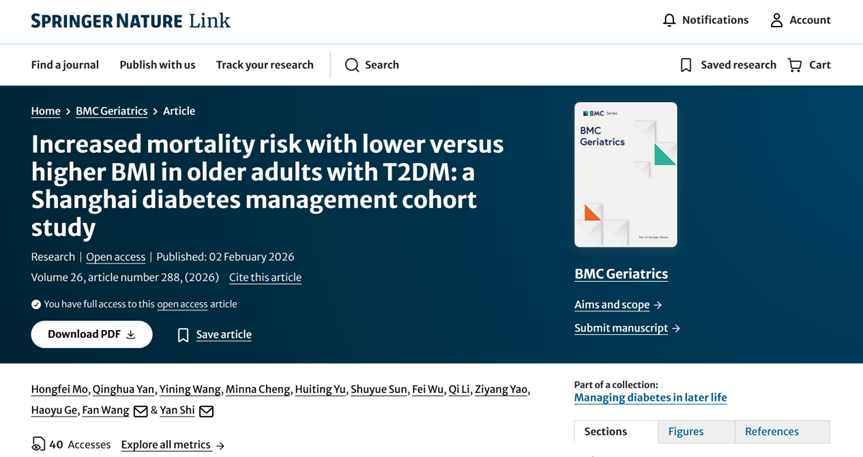
近日,由我院王帆教授(共同通讯作者)、公共卫生学院博士生莫鸿飞(共同第一作者),以及上海市疾病预防控制中心施燕主任(共同通讯作者)、严青华副主任医师(共同第一作者)等专家合作完成的论文“Increased mortality risk with lower versus higher BMI in older adults with T2DM: a Shanghai diabetes management cohort study”发表于期刊《BMC Geriatrics》(SCIE/SSCI双收录,JCR Q1)。该期刊是老年学/老年医学领域权威期刊,聚焦老年人群常见疾病的流行病学、临床管理及公共卫生干预,涵盖衰老相关慢性病的预防、诊疗及预后研究。本研究成果体现了王帆教授团队在社区体重管理方面的积极探索。
本研究基于上海市糖尿病管理队列,系统探讨了老年2型糖尿病患者中BMI与全因死亡风险的剂量-反应关系,进一步验证了“肥胖生存悖论”在该人群中的存在,为老年糖尿病患者的体重管理提供了新的科学依据。研究发现,老年T2DM患者的BMI与全因死亡风险呈U型关系,最低风险点对应BMI为22.68。低BMI(<22.68)显著增加死亡风险,而高BMI虽与死亡风险正相关,但效应较弱。进一步分析显示,BMI低于20.41或21.55的人群生存概率显著下降,而高于24.95或23.81者与参考组无显著差异。研究提示,在老年2型糖尿病患者中,低BMI带来的风险远高于高BMI,体重管理策略应优先避免低BMI,而非盲目追求减重。该成果为中国老年糖尿病人群BMI管理提供了具体的参考阈值(22.68)和安全区间(20.41~24.95),对优化个体化干预策略具有重要临床与公共卫生意义。
作者/Authors
Hongfei Mo1,2†, Qinghua Yan3†, Yining Wang1, Minna Cheng3, Huiting Yu4, Shuyue Sun1,2, Fei Wu3, Qi Li4, Ziyang Yao2, Haoyu Ge2, Fan Wang2,5*, Yan Shi3*
1. School of Public Health, Fudan University, Shanghai, P.R.China
2. Fudan Development Institute, Fudan University, Shanghai, P.R.China
3. Institute for Chronic Non-communicable Diseases Control, Shanghai Municipal Center for Disease Control and Prevention, Shanghai, P.R.China
4. Institute of Health Information, Shanghai Municipal Center for Disease Control and Prevention, Shanghai, P.R.China
5. Health Communication Institute, Fudan University, Shanghai, P.R.China
†Hongfei Mo and Qinghua Yan contributed equally as co-first authors.
*Correspondence to Yan Shi or Fan Wang
摘要/Abstract
目的 本研究旨在探讨上海市老年2型糖尿病(T2DM)患者身体质量指数(BMI)与全因死亡率之间的关系,确定最佳BMI阈值及安全区间,并分析低BMI和高BMI对死亡风险的非对称性影响。
方法 这项大规模社区队列研究基于上海市疾病预防控制中心的糖尿病管理队列。共纳入372,829名年龄≥60岁的T2DM患者,随访时间为2020年5月1日至2024年12月31日,中位随访期为19个月。BMI通过标准化测量及自我报告的身高和体重(kg/m²)计算得出。全因死亡率数据与上海市死亡登记系统进行匹配。协变量包括性别、年龄、婚姻状况、教育水平、吸烟、饮酒和体力活动。统计分析采用限制性立方样条(RCS)分析来探索BMI与死亡风险之间的剂量-反应关系,并确定最佳截断值。进一步使用Cox回归和Kaplan-Meier(KM)生存曲线比较不同BMI组别,以评估风险差异。采用±5%和±10%的BMI区间验证风险梯度,并对协变量进行调整。显著性水平设定为α=0.05。
结果 RCS曲线显示,BMI与全因死亡率之间呈U型关系,确定BMI为22.68时为死亡风险最低点(协变量调整模型,非线性检验P<0.001)。风险呈现非对称性:低BMI(<22.68)显著增加死亡风险(HR=0.86,95%CI:0.82~0.88,P<0.001),而高BMI与死亡风险呈正相关(HR=1.01,95%CI:1.01~1.02,P<0.001),但效应量较弱。分层分析显示,与参考组(21.55~23.81)相比,BMI<21.55(-5%区间)的生存概率显著降低(P<0.001),而BMI>23.81(+5%区间)的生存概率与参考组在KM曲线上无显著差异。同样,与参考组(20.41~24.95)相比,BMI<20.41(-10%区间)的生存概率显著降低(P<0.001),而BMI>24.95(+10%区间)在KM曲线上与参考组相比无显著差异。
结论 在老年T2DM患者中存在肥胖生存悖论,低BMI显著增加死亡风险,而高BMI的保护作用可能部分抵消其代谢危害,导致其风险效应量较低。这些发现提示,老年T2DM患者的体重管理策略应优先考虑避免低BMI,而非激进地减重。
Objective This study aims to investigate the relationship between body mass index (BMI) and all-cause mortality among older adults with type 2 diabetes mellitus (T2DM) in Shanghai, seeking to determine the optimal BMI threshold and safe range, as well as to analyze the asymmetric effects of low and high BMI on mortality risk.
Methods This large-scale community cohort study is based on the diabetes management cohort from the Shanghai Municipal Center for Disease Control and Prevention. A total of 372,829 T2DM patients age ≥60 were included, with a follow-up period from May 1, 2020, to Dec 31, 2024, and a median follow-up of 19 months. BMI was calculated using standardized measurements and self-reported height and weight (kg/m²). All-cause mortality data were matched from the Shanghai Death Registry System. Covariates included sex, age, marital status, education level, smoking, alcohol, and physical activity. Statistical analysis utilized Restricted Cubic Spline (RCS) analysis to explore the dose-response relationship between BMI and mortality risk, identifying the optimal cutoff point. BMI groups were further compared using Cox regression and Kaplan-Meier (KM) survival curves to assess risk differences. BMI intervals of ±5% and ±10% were used to verify risk gradients, with adjustments for covariates. The significance level was set at α=0.05.
Results The RCS curve revealed a U-shaped relationship between BMI and all-cause mortality, identifying a BMI of 22.68 as the point of lowest mortality risk (covariates adjusted model, P for nonlinear <0.001). The risk was asymmetric: a low BMI (22.68) significantly increased mortality risk (HR=0.86, 95%CI: 0.82~0.88, P <0.001), while high BMI was positively correlated with mortality risk (HR=1.01, 95%CI: 1.01~1.02, P <0.001) but with a weaker effect size. Stratified analysis showed that BMI <21.55 (-5% interval) was associated with significantly lower survival probability compared to the reference group (21.55~23.81) (P <0.001), whereas BMI >23.81 (+5% interval) had survival probabilities that were not significantly different from those of the reference group on the KM curve. Similarly, BMI <20.41 (-10% interval) had significantly lower survival probability than the reference group (20.41~24.95) (P <0.001), while BMI >24.95 (+10% interval) showed no statistically significant difference compared to the reference group on the KM curve.
Conclusions There is an obesity survival paradox among T2DM older adults, with low BMI significantly increasing mortality risk, while the protective effects of high BMI may partially counterbalance its metabolic harms, resulting in a lower effect size of risk. These findings suggest that weight management strategies for older adults with T2DM should prioritize the avoidance of low BMI over aggressive weight reduction.
关键词/Key Words
全因死亡率;身体质量指数;肥胖悖论;老年2型糖尿病;限制性立方样条;上海队列
All-cause mortality; Body mass index (BMI); Obesity paradox; Type 2 diabetes mellitus (T2DM) in older adults; Restricted cubic splines (RCS); Shanghai cohort
全文链接/Link
https://link.springer.com/article/10.1186/s12877-026-07017-5

CopyRight©2007 复旦发展研究院版权所有 备案号/经营许可号:沪ICP备05006147号
地址:上海市邯郸路220号智库楼 邮编:200433 电话:86-21-55670203 传真:86-21-55670203
电子邮箱:fdifudan@fudan.edu.cn