
作者:FDDI 发布时间:2026-04-17 21:46:42 来源:复旦发展研究院+收藏本文
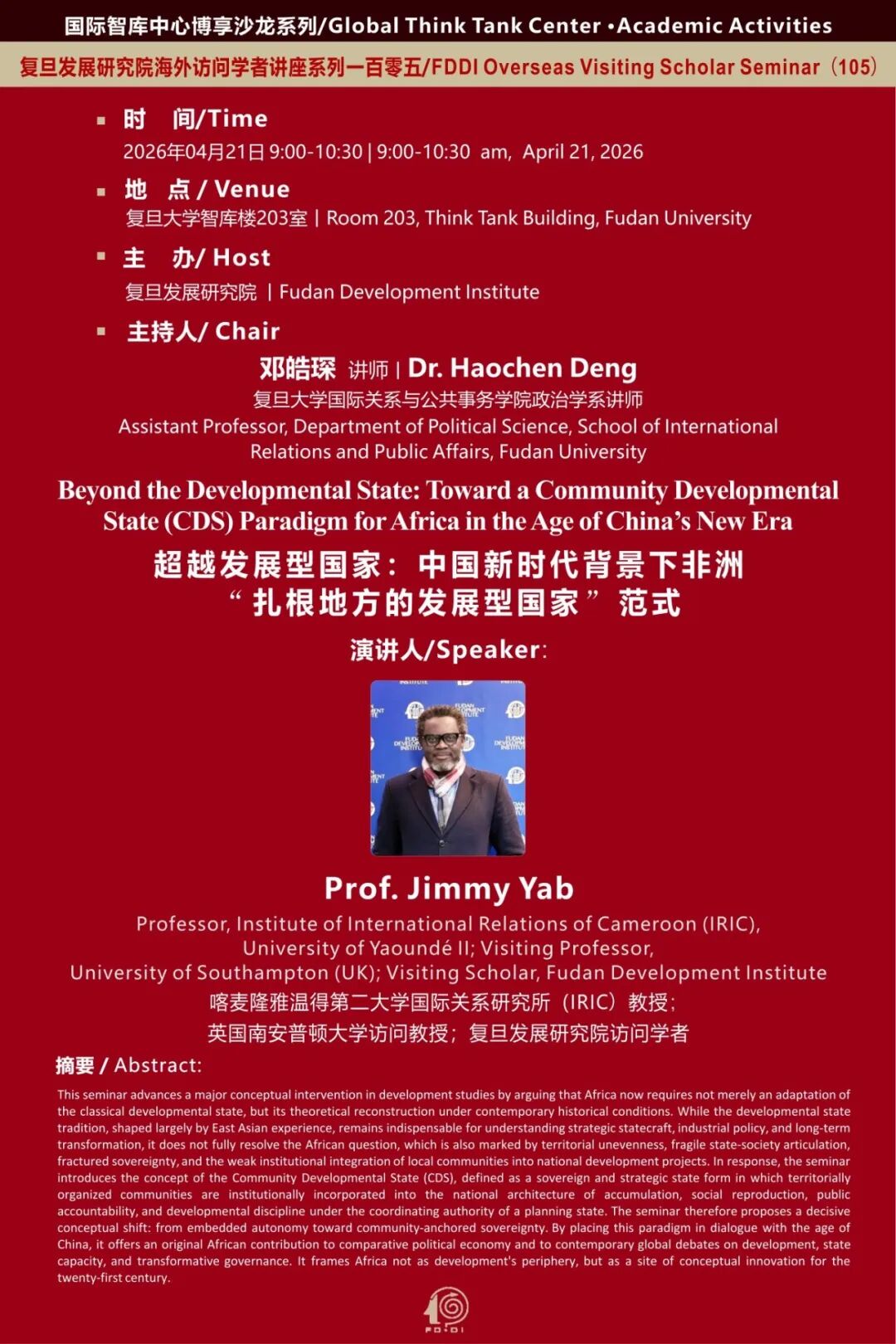
国际智库中心博享沙龙系列
Global Think Tank Center Academic Activities
复旦发展研究院海外访问学者讲座系列105期
FDDI Overseas Visiting Scholar Seminar (105)
Beyond the Developmental State:
Toward a Community Developmental
State (CDS) Paradigm for Africa in the Age of China’s New Era
超越发展型国家:
中国新时代背景下非洲
“扎根地方的发展型国家”范式
演讲人
Speaker
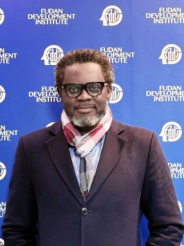
Prof. Jimmy Yab
喀麦隆雅温得第二大学
国际关系研究所(IRIC)教授,
英国南安普顿大学访问教授,
复旦发展研究院访问学者
Professor, Institute of International Relations
of Cameroon (IRIC),
University of Yaoundé II;
Visiting Professor,
University of Southampton (UK);
Visiting Scholar,
Fudan Development Institute
主持人
Chair
邓皓琛
Dr. Haochen Deng
复旦大学国际关系与公共事务学院
政治学系讲师
Assistant Professor,
Department of Political Science,
School of International
Relations and Public Affairs,
Fudan University
主 办
Host
全球人工智能创新治理中心
Center for Global AI Innovative Governance
主 办
Host
复旦发展研究院
Fudan Development Institute
时 间
Time
2026年4月21日 9:00-10:30
9:00-10:30 am, April 21, 2026
地 点
Venue
复旦大学智库楼203室
Room 203, Think Tank Building,
Fudan University
摘要
Abstract
This seminar advances a major conceptual intervention in development studies by arguing that Africa now requires not merely an adaptation of the classical developmental state, but its theoretical reconstruction under contemporary historical conditions. While the developmental state tradition, shaped largely by East Asian experience, remains indispensable for understanding strategic statecraft, industrial policy, and long-term transformation, it does not fully resolve the African question, which is also marked by territorial unevenness, fragile state-society articulation, fractured sovereignty, and the weak institutional integration of local communities into national development projects. In response, the seminar introduces the concept of the Community Developmental State (CDS), defined as a sovereign and strategic state form in which territorially organized communities are institutionally incorporated into the national architecture of accumulation, social reproduction, public accountability, and developmental discipline under the coordinating authority of a planning state. The seminar therefore proposes a decisive conceptual shift: from embedded autonomy toward community-anchored sovereignty. By placing this paradigm in dialogue with the age of China, it offers an original African contribution to comparative political economy and to contemporary global debates on development, state capacity, and transformative governance. It frames Africa not as development's periphery, but as a site of conceptual innovation for the twenty-first century.

CopyRight©2007 复旦发展研究院版权所有 备案号/经营许可号:沪ICP备05006147号
地址:上海市邯郸路220号智库楼 邮编:200433 电话:86-21-55670203 传真:86-21-55670203
电子邮箱:fdifudan@fudan.edu.cn