
作者:江天骄、张书言 发布时间:2026-06-13 23:52:25 来源:国际政治研究+收藏本文
摘要
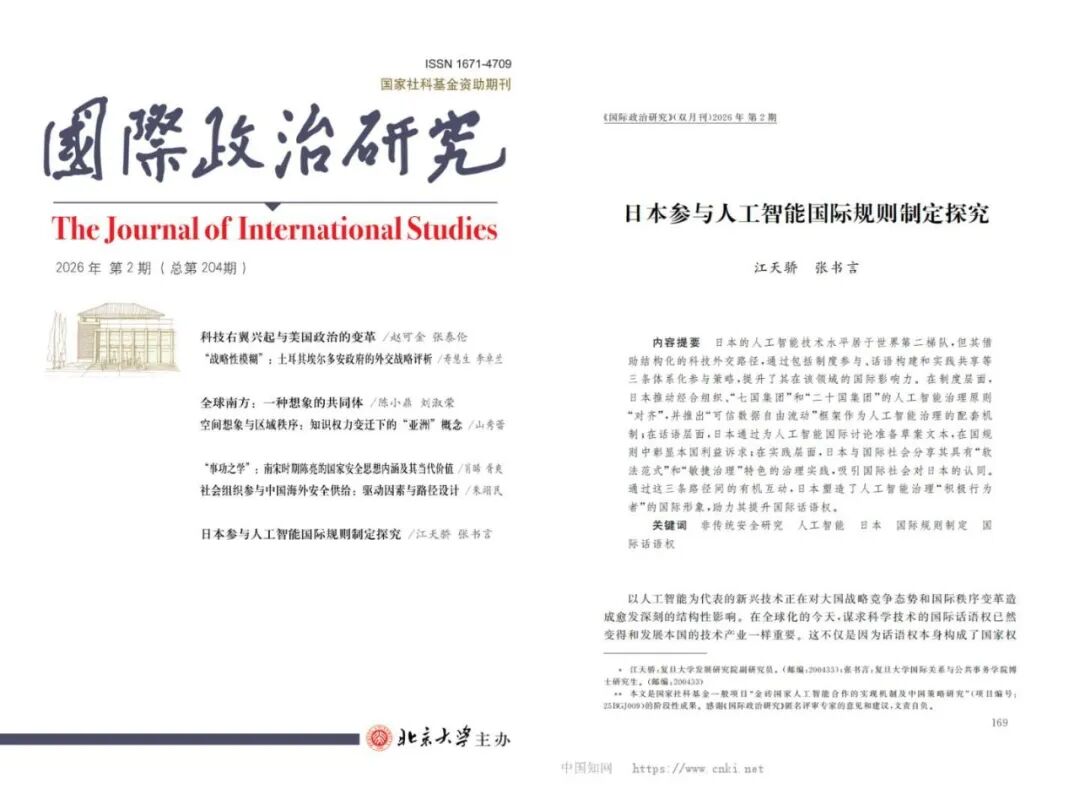
日本的人工智能技术水平居于世界第二梯队,但其借助结构化的科技外交路径,通过包括制度参与、话语构建和实践共享等三条体系化参与策略,提升了其在该领域的国际影响力。在制度层面,日本推动经合组织、“七国集团”和“二十国集团”的人工智能治理原则“对齐”,并推出“可信数据自由流动”框架作为人工智能治理的配套机制;在话语层面,日本通过为人工智能国际讨论准备草案文本,在国际规则中彰显本国利益诉求;在实践层面,日本与国际社会分享其具有“软法范式”和“敏捷治理”特色的治理实践,吸引国际社会对日本的认同。通过这三条路径间的有机互动,日本塑造了人工智能治理“积极行为者”的国际形象,助力其提升国际话语权。
关键词
非传统安全研究;人工智能;日本;国际规则制定;国际话语权
作者介绍
江天骄
全球人工智能创新治理中心研究员,复旦大学发展研究院副研究员;
张书言
全球人工智能创新治理中心科研助理,复旦大学国际关系与公共事务学院博士研究生。
文章来源
《日本参与人工智能国际规则制定探究》,载《国际政治研究》2026年第2期(江天骄、张书言)
Systemic Strategy: Japan’s Path toward Participating in International AI Governance Rule-Making
Abstract
Japan's overall Al capability ranks in the world's second tier. Nevertheless, through a structured science and technology diplomacy approach, it has effectively enhanced its international influence in this field by employing three strategies: institutional participation, discourse construction, and practice sharing. At the institutional level, Japan has actively promoted the alignment of Al governance principles among the OECD, the G7, and the G20 and has introduced the Data Free Flow with Trust (DFFT) framework as a supporting mechanism for Al governance. At the discourse level, Japan prepares draft texts for international Al discussions to highlight its national interests in international rule-making. At the practical level, Japan shares with the international community its governance practices characterized by a soft law paradigm and agile governance, thereby attracting international recognition. Through the interaction among these three approaches, Japan has shaped its international image as an active actor in global Al governance, helping to strengthen its international discursive power.
Keywords
Non-traditional security studies; AI; Japan; International rule-making; International discursive power
Authors
Jiang Tianjiao and Zhang Shuyan
Source
Jiang, T. J. & Zhang, S. Y. (2026). Systemic Strategy: Japan’s Path toward Participating in International AI Governance Rule-Making. The Journal of International Studies, (2).

CopyRight©2007 复旦发展研究院版权所有 备案号/经营许可号:沪ICP备05006147号
地址:上海市邯郸路220号智库楼 邮编:200433 电话:86-21-55670203 传真:86-21-55670203
电子邮箱:fdifudan@fudan.edu.cn