Author:Zhongyang Li, Qin Li, Yushun Chen,et al. Release date:2026-09-21 11:07:59Source:Water Biology and Security
Authors
Zhongyang Li, Sebastien Brosse, Wenqi Gao, Fangyuan Xiong, Piao Sheng, Chiping Kong, Wei Xin, Qin Li, Yushun Chen
Abstract
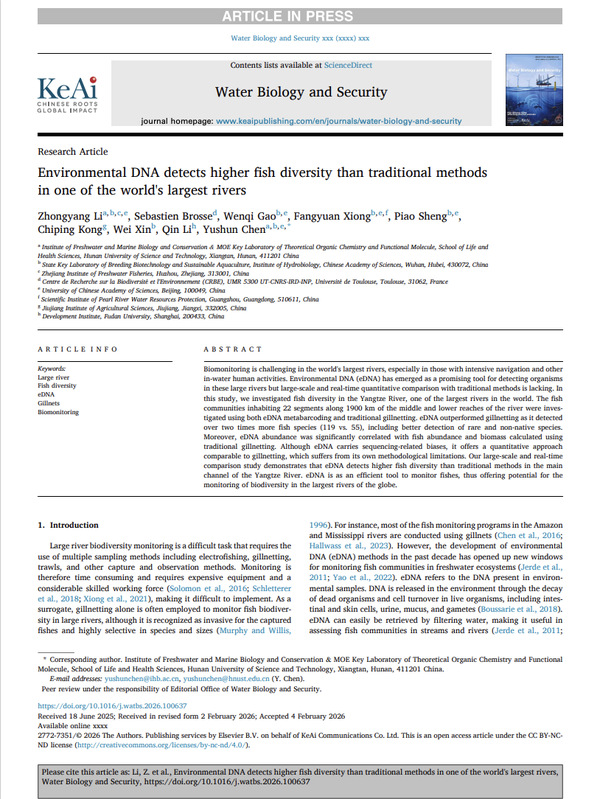
Biomonitoring is challenging in the world's largest rivers, especially in those with intensive navigation and other in-water human activities. Environmental DNA (eDNA) has emerged as a promising tool for detecting organisms in these large rivers but large-scale and real-time quantitative comparison with traditional methods is lacking. In this study, we investigated fish diversity in the Yangtze River, one of the largest rivers in the world. The fish communities inhabiting 22 segments along 1900 km of the middle and lower reaches of the river were investigated using both eDNA metabarcoding and traditional gillnetting. eDNA outperformed gillnetting as it detected over two times more fish species (119 vs. 55), including better detection of rare and non-native species. Moreover, eDNA abundance was significantly correlated with fish abundance and biomass calculated using traditional gillnetting. Although eDNA carries sequencing-related biases, it offers a quantitative approach comparable to gillnetting, which suffers from its own methodological limitations. Our large-scale and real-time comparison study demonstrates that eDNA detects higher fish diversity than traditional methods in the main channel of the Yangtze River. eDNA is as an efficient tool to monitor fishes, thus offering potential for the monitoring of biodiversity in the largest rivers of the globe.
Keywords
Large river; Fish diversity; eDNA; Gillnets; Biomonitoring
Original link
https://www.sciencedirect.com/science/article/pii/S2772735126000910

CopyRight©2007 复旦发展研究院版权所有 备案号/经营许可号:沪ICP备05006147号
地址:上海市邯郸路220号智库楼 邮编:200433 电话:86-21-55670203 传真:86-21-55670203
电子邮箱:fdifudan@fudan.edu.cn