Author:Li Q., Kuang J., Du J., et al. Release date:2026-09-21 11:20:48Source:The Innovation Water
Authors
Li Q., Kuang J., Du J., et al.
Abstract
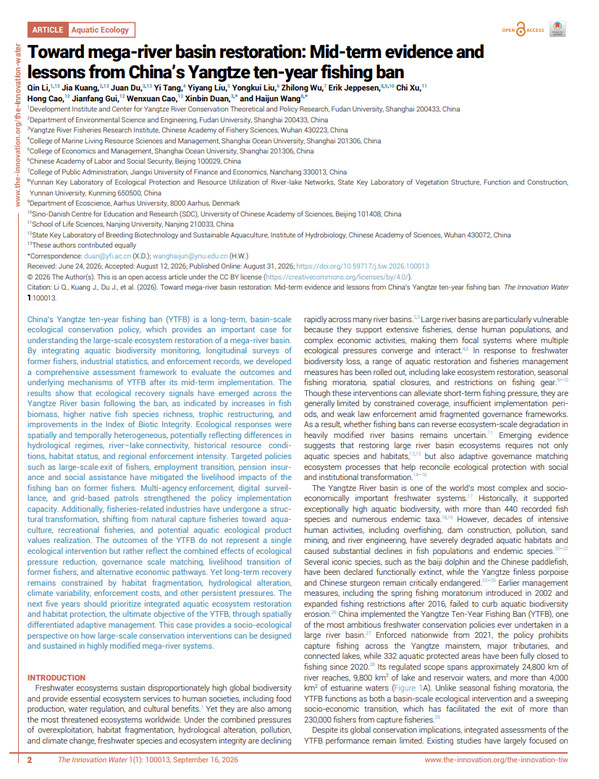
China’s Yangtze ten-year fishing ban (YTFB) is a long-term, basin-scale ecological conservation policy, which provides an important case for understanding the large-scale ecosystem restoration of a mega-river basin. By integrating aquatic biodiversity monitoring, longitudinal surveys of former fishers, industrial statistics, and enforcement records, we developed a comprehensive assessment framework to evaluate the outcomes and underlying mechanisms of YTFB after its mid-term implementation. The results show that ecological recovery signals have emerged across the Yangtze River basin following the ban, as indicated by increases in fish biomass, higher native fish species richness, trophic restructuring, and improvements in the Index of Biotic Integrity. Ecological responses were spatially and temporally heterogeneous, potentially reflecting differences in hydrological regimes, river–lake connectivity, historical resource conditions, habitat status, and regional enforcement intensity. Targeted policies such as large-scale exit of fishers, employment transition, pension insurance and social assistance have mitigated the livelihood impacts of the fishing ban on former fishers. Multi-agency enforcement, digital surveillance, and grid-based patrols strengthened the policy implementation capacity. Additionally, fisheries-related industries have undergone a structural transformation, shifting from natural capture fisheries toward aquaculture, recreational fisheries, and potential aquatic ecological product values realization. The outcomes of the YTFB do not represent a single ecological intervention but rather reflect the combined effects of ecological pressure reduction, governance scale matching, livelihood transition of former fishers, and alternative economic pathways. Yet long-term recovery remains constrained by habitat fragmentation, hydrological alteration, climate variability, enforcement costs, and other persistent pressures. The next five years should prioritize integrated aquatic ecosystem restoration and habitat protection, the ultimate objective of the YTFB, through spatially differentiated adaptive management. This case provides a socio-ecological perspective on how large-scale conservation interventions can be designed and sustained in highly modified mega-river systems.
Keywords
Yangtze River / Ten-Year Fishing Ban / Freshwater ecosystem restoration / Socio-ecological systems / fisheries transition / River basin governance
Original link
https://www.the-innovation.org/article/doi/10.59717/j.tiw.2026.100013

CopyRight©2007 复旦发展研究院版权所有 备案号/经营许可号:沪ICP备05006147号
地址:上海市邯郸路220号智库楼 邮编:200433 电话:86-21-55670203 传真:86-21-55670203
电子邮箱:fdifudan@fudan.edu.cn