作者:FDDI 发布时间:2025-12-01 来源:复旦发展研究院+收藏本文
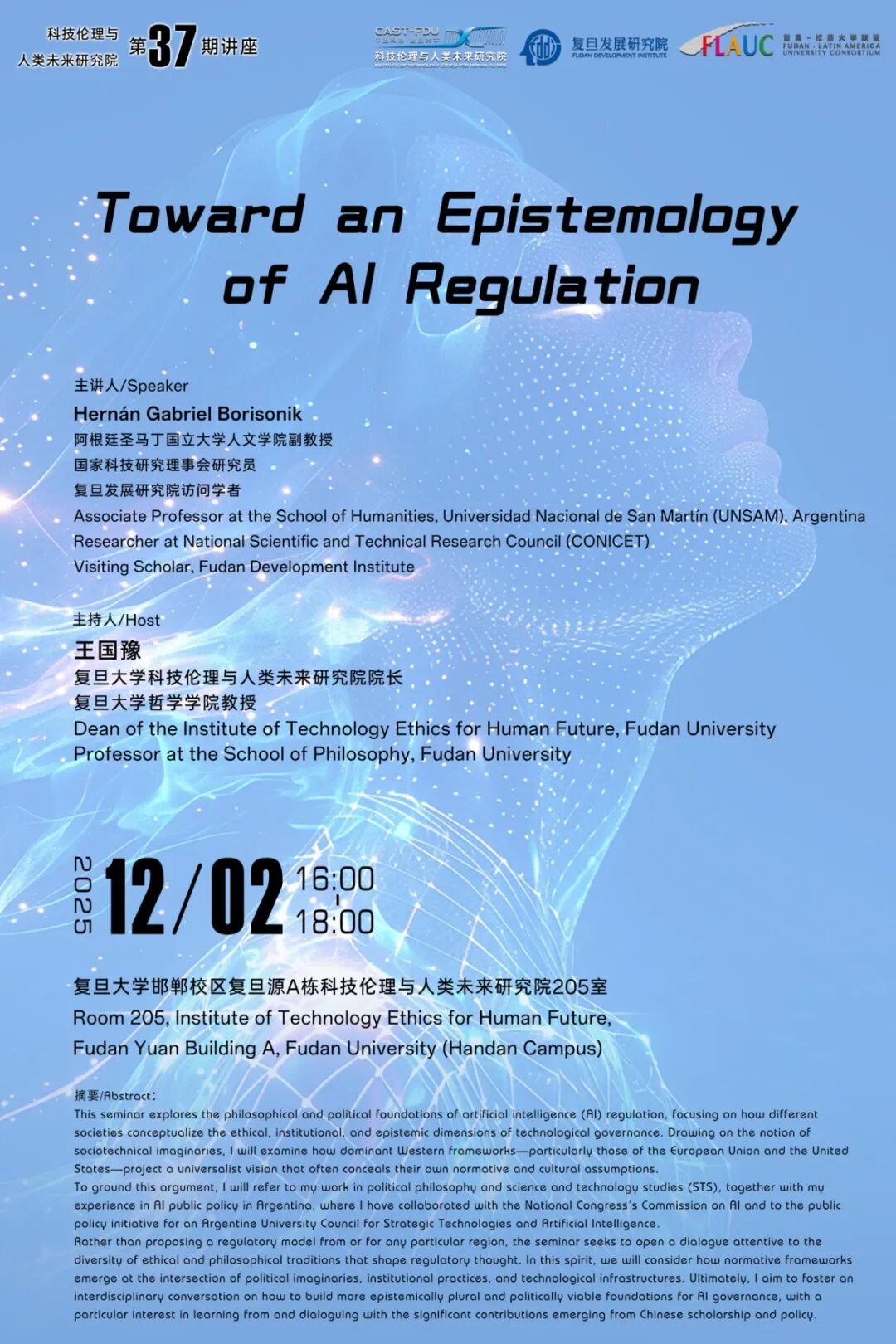
主题 Topic
Toward an Epistemology of Al Regulation
主持人 Chair
王国豫
复旦大学科技伦理与人类未来研究院院长
复旦大学哲学学院教授
Dean of the Institute of Technology Ethics
for Human Future, Fudan University
Professor at the School of Philosophy, Fudan University
报告人 Speaker
Hernán Gabriel Borisonik
阿根廷圣马丁国立大学人文学院副教授
国家科技研究理事会研究员
复旦发展研究院访问学者
Associate Professor at the School of Humanities, Universidad Nacional de San Martin (UNSAM)
Argentina Researcher at National Scientific
and Technical Research Council (CONICET)
Visiting Scholar, Fudan Development Institute
时间 Time
2025年12月2日(星期二)16:00-18:00
16:00-18:00, December 2nd, 2025 (Tue)
活动地点 Venue
复旦大学邯郸校区
复旦源A栋科技伦理与人类未来研究院205室
Room 205, Institute of Technology Ethics
for Human Future,
Fudan Yuan Building A,
Fudan University (Handan Campus)
主办 Host
科技伦理与人类未来研究院
Institute of Technology Ethics for Human Future
复旦发展研究院
Fudan Development Institute
复旦-拉美大学联盟
Fudan-Latin America, University Consortium
摘要 Abstract
This seminar explores the philosophical and political foundations of artificial intelligence (Al) regulation, focusing on how different societies conceptualize the ethical, institutional, and epistemic dimensions of technological governance. Drawing on the notion ofsociotechnical imaginaries, l will examine how dominant Western frameworks-particularly those of the European Union and the United States-project a universalist vision that often conceals their own normative and cultural assumptions. To ground this argument, l will refer to my work in political philosophy and science and technology studies (STS), together with my experience in Al public policy in Argentina, where l have collaborated with the National Congress's Commission on Al and to the public policy initiative for an Argentine University Council for Strategic Technologies and Artificial lntelligence. Rather than proposing a regulatory model from or for any particular region, the seminar seeks to open a dialogue attentive to the diversity of ethical and philosophical traditions that shape regulatory thought, in this spirit, we will consider how normative frameworks emerge at the intersection of political imaginaries, institutional practices, and technological infrastructures. Ultimately, l aim to foster an interdisciplinary conversation on how to build more epistemically plural and politically viable foundations for Al governance, with a particular interest in learning from and dialoguing with the significant contributions emerging from Chinese scholarship and policy.

地址:上海市邯郸路220号智库楼
邮编:200433
电话:86-21-55670203
传真:86-21-55670203
电子邮箱:fdifudan@fudan.edu.cn
CopyRight©2007 复旦发展研究院版权所有 备案号/经营许可号:沪ICP备05006147号