作者:YANG RAN 发布时间:2026-07-25 来源:China Daily July 23, 2026+收藏本文
随着人工智能技术快速发展,全球人工智能鸿沟日益扩大,成为影响全球南方国家技术发展与治理参与的重要挑战。联合国等机构数据显示,全球南方在人工智能应用、基础设施建设和治理能力方面明显落后于发达经济体,技术依赖与数字不平等风险不断加剧。对此,复旦发展研究员副教授、全球人工智能创新治理中心研究员江天骄,复旦发展研究院访问学者、阿根廷圣马丁国立大学科学与思想中心主任赫尔南·加布里埃尔·博里索尼克(Hernán Gabriel Borisonik)在接受China Daily采访时对有关议题进行了观点分享。
江天骄指出,全球南方掌握大量具有价值的本地场景数据,但由于缺乏计算能力和基础设施,数据往往流向国外处理,可能导致“数据来源于南方、收益留在北方”的结构性不平等,进一步形成新的技术依附关系。Hernán Borisonik则提出,技术壁垒不仅会造成重复建设和标准竞争,也可能削弱国际社会应对算法偏见等共同风险的能力。人工智能治理需要建立真正具有全球视野的合作框架,在竞争环境中实现共存与相互影响,而中国在全球AI治理中的举措是减少结构性不平等的有效途径之一。以下为China Daily原文。
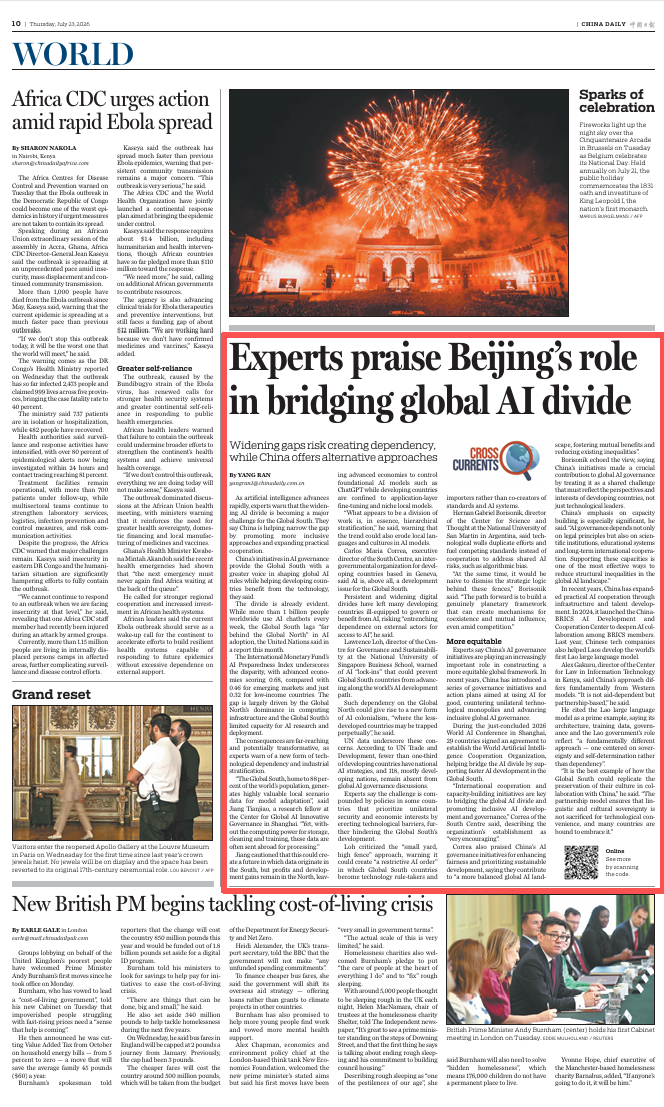
As artificial intelligence advances rapidly, experts warn that the widening AI divide is becoming a major challenge for the Global South. They say China is helping narrow the gap by promoting more inclusive approaches and expanding practical cooperation.
China's initiatives in AI governance provide the Global South with a greater voice in shaping global AI rules while helping developing countries benefit from the technology, they said.
The divide is already evident. While more than 1 billion people worldwide use AI chatbots every week, the Global South lags far behind the Global North in AI adoption, the United Nations said in a report this month.
The International Monetary Fund's AI Preparedness Index underscores the disparity, with advanced economies scoring 0.68, compared with 0.46 for emerging markets and just 0.32 for low-income countries. The gap is largely driven by the Global North's dominance in computing infrastructure and the Global South's limited capacity for AI research and deployment.
The consequences are far-reaching and potentially transformative, as experts warn of a new form of technological dependency and industrial stratification.
The Global South, home to 88 percent of the world's population, generates highly valuable local scenario data for model adaptation, said Jiang Tianjiao, a research fellow at the Center for Global AI Innovative Governance in Shanghai. Yet, without the computing power for storage, cleaning and training, these data are often sent abroad for processing.
Jiang cautioned that this could create a future in which data originate in the South, but profits and development gains remain in the North, leaving advanced economies to control foundational AI models such as ChatGPT while developing countries are confined to application-layer fine-tuning and niche local models.
What appears to be a division of work is, in essence, hierarchical stratification, he said, warning that the trend could also erode local languages and cultures in AI models.
Carlos Maria Correa, executive director of the South Centre, an intergovernmental organization for developing countries based in Geneva, said AI is, above all, a development issue for the Global South.
Persistent and widening digital divides have left many developing countries ill-equipped to govern or benefit from AI, risking entrenching dependence on external actors for access to AI, he said.
Lawrence Loh, director of the Centre for Governance and Sustainability at the National University of Singapore Business School, warned of AI lock-ins that could prevent Global South countries from advancing along the world's AI development path.
Such dependency on the Global North could give rise to a new form of AI colonialism, where the less-developed countries may be trapped perpetually, he said.
UN data underscore these concerns. According to UN Trade and Development, fewer than one-third of developing countries have national AI strategies, and 118, mostly developing nations, remain absent from global AI governance discussions.
Experts say the challenge is compounded by policies in some countries that prioritize unilateral security and economic interests by erecting technological barriers, further hindering the Global South's development.
Loh criticized the small yard, high fence approach, warning it could create a restrictive AI order in which Global South countries become technology rule-takers and importers rather than co-creators of standards and AI systems.
Hernan Gabriel Borisonik, director of the Center for Science and Thought at the National University of San Martin in Argentina, said technological walls duplicate efforts and fuel competing standards instead of cooperation to address shared AI risks, such as algorithmic bias.
At the same time, it would be naive to dismiss the strategic logic behind these fences, Borisonik said. The path forward is to build a genuinely planetary framework that can create mechanisms for coexistence and mutual influence, even amid competition.
More equitable
Experts say China's AI governance initiatives are playing an increasingly important role in constructing a more equitable global framework. In recent years, China has introduced a series of governance initiatives and action plans aimed at using AI for good, countering unilateral technological monopolies and advancing inclusive global AI governance.
During the just-concluded 2026 World AI Conference in Shanghai, 29 countries signed an agreement to establish the World Artificial Intelligence Cooperation Organization, helping bridge the AI divide by supporting faster AI development in the Global South.
International cooperation and capacity-building initiatives are key to bridging the global AI divide and promoting inclusive AI development and governance, Correa of the South Centre said, describing the organization's establishment as very encouraging.
Correa also praised China's AI governance initiatives for enhancing fairness and prioritizing sustainable development, saying they contribute to a more balanced global AI landscape, fostering mutual benefits and reducing existing inequalities.
Borisonik echoed the view, saying China's initiatives made a crucial contribution to global AI governance by treating it as a shared challenge that must reflect the perspectives and interests of developing countries, not just technological leaders.
China's emphasis on capacity building is especially significant, he said. AI governance depends not only on legal principles but also on scientific institutions, educational systems and long-term international cooperation. Supporting these capacities is one of the most effective ways to reduce structural inequalities in the global AI landscape.
In recent years, China has expanded practical AI cooperation through infrastructure and talent development. In 2024, it launched the China-BRICS AI Development and Cooperation Center to deepen AI collaboration among BRICS members. Last year, Chinese tech companies also helped Laos develop the world's first Lao large language model.
Alex Gakuru, director of the Center for Law in Information Technology in Kenya, said China's approach differs fundamentally from Western models. It is not aid-dependent but partnership-based, he said.
He cited the Lao large language model as a prime example, saying its architecture, training data, governance and the Lao government's role reflect a fundamentally different approach — one centered on sovereignty and self-determination rather than dependency.
It is the best example of how the Global South could replicate the preservation of their culture in collaboration with China, he said. The partnership model ensures that linguistic and cultural sovereignty is not sacrificed for technological convenience, and many countries are bound to embrace it.
原文链接:https://enapp.chinadaily.com.cn/a/202607/23/AP6a6178cea3108d4743bc0ac9.html?sessionid=

地址:上海市邯郸路220号智库楼
邮编:200433
电话:86-21-55670203
传真:86-21-55670203
电子邮箱:fdifudan@fudan.edu.cn
CopyRight©2007 复旦发展研究院版权所有 备案号/经营许可号:沪ICP备05006147号