作者:江天骄 发布时间:2026-07-31 来源:北京周报+收藏本文
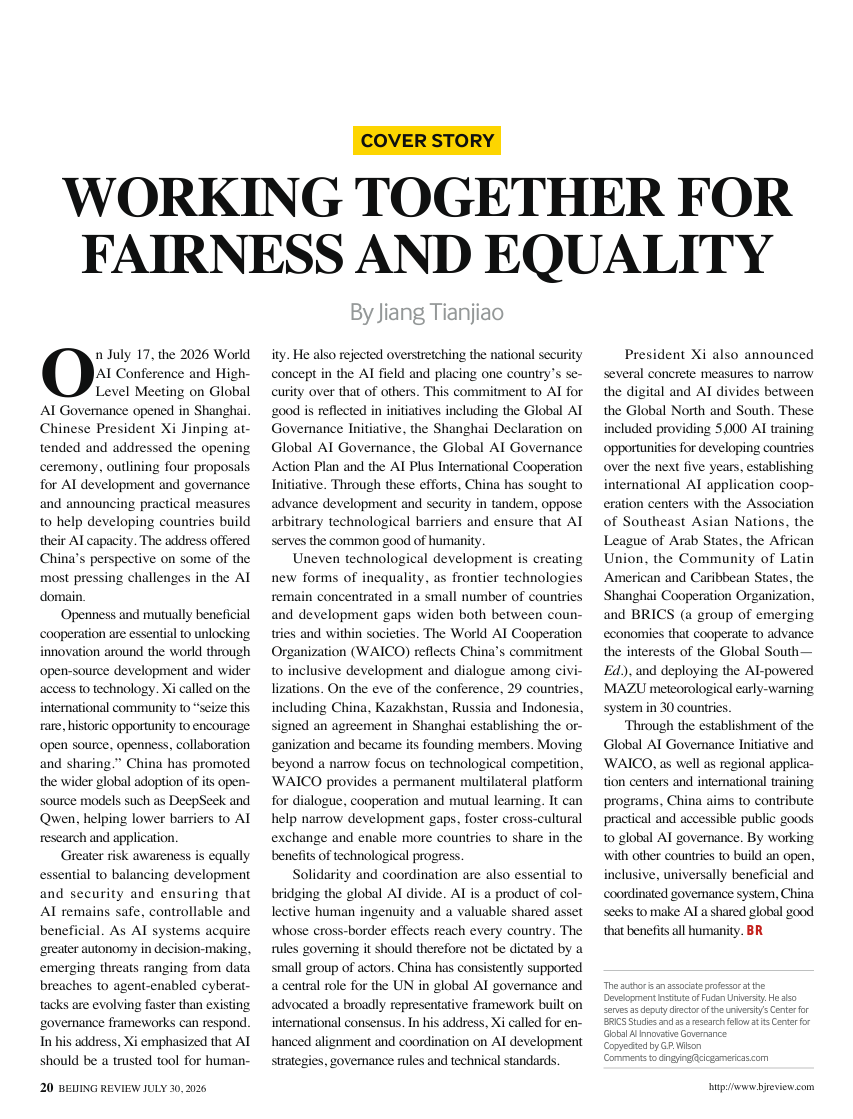
2026年7月17日,2026世界人工智能大会暨人工智能全球治理高级别会议在上海开幕。国家主席习近平出席开幕式并发表致辞,围绕人工智能发展与治理提出重要倡议,强调推动开放合作、平衡发展与安全、加强全球协同治理,为人工智能时代的国际合作提供中国方案。复旦发展研究院江天骄副教授在《北京周报》撰文指出,人工智能作为具有全球影响力的前沿技术,不应成为少数国家竞争和垄断的工具,而应成为促进人类共同发展的公共资源。江天骄提出,开放源代码、扩大技术共享、完善全球人工智能治理体系是释放人工智能创新潜力的重要路径。与此同时,面对技术发展带来的数据安全、网络风险和发展鸿沟,需要坚持发展与安全并重,推动建立更加开放、包容、普惠的国际人工智能合作机制,让更多国家共享技术进步成果。
江天骄
复旦大学发展研究院副教授,金砖国际研究中心副主任,全球人工智能创新治理中心研究员
The author is an associate professor at the Development Institute of Fudan University. He also serves as deputy director of the university’s Center for BRICS Studies and as a research fellow at its Center for Global AI Innovative Governance.
On July 17, the 2026 World AI Conference and High-Level Meeting on Global AI Governance opened in Shanghai. Chinese President Xi Jinping attended and addressed the opening ceremony, outlining four proposals for AI development and governance and announcing practical measures to help developing countries build their AI capacity. The address offered China’s perspective on some of the most pressing challenges in the AI domain.
Openness and mutually beneficial cooperation are essential to unlocking innovation around the world through open-source development and wider access to technology. Xi called on the international community to “seize this rare, historic opportunity to encourage open source, openness, collaboration and sharing.” China has promoted the wider global adoption of its open-source models such as DeepSeek and Qwen, helping lower barriers to AI research and application.
Greater risk awareness is equally essential to balancing development and security and ensuring that AI remains safe, controllable and beneficial. As AI systems acquire greater autonomy in decision-making, emerging threats ranging from data breaches to agent-enabled cyberattacks are evolving faster than existing governance frameworks can respond. In his address, Xi emphasized that AI should be a trusted tool for humanity. He also rejected overstretching the national security concept in the AI field and placing one country’s security over that of others. This commitment to AI for good is reflected in initiatives including the Global AI Governance Initiative, the Shanghai Declaration on Global AI Governance, the Global AI Governance Action Plan and the AI Plus International Cooperation Initiative. Through these efforts, China has sought to advance development and security in tandem, oppose arbitrary technological barriers and ensure that AI serves the common good of humanity.
Uneven technological development is creating new forms of inequality, as frontier technologies remain concentrated in a small number of countries and development gaps widen both between countries and within societies. The World AI Cooperation Organization (WAICO) reflects China’s commitment to inclusive development and dialogue among civilizations. On the eve of the conference, 29 countries, including China, Kazakhstan, Russia and Indonesia, signed an agreement in Shanghai establishing the organization and became its founding members. Moving beyond a narrow focus on technological competition, WAICO provides a permanent multilateral platform for dialogue, cooperation and mutual learning. It can help narrow development gaps, foster cross-cultural exchange and enable more countries to share in the benefits of technological progress.
Solidarity and coordination are also essential to bridging the global AI divide. AI is a product of collective human ingenuity and a valuable shared asset whose cross-border effects reach every country. The rules governing it should therefore not be dictated by a small group of actors. China has consistently supported a central role for the UN in global AI governance and advocated a broadly representative framework built on international consensus. In his address, Xi called for enhanced alignment and coordination on AI development strategies, governance rules and technical standards.
President Xi also announced several concrete measures to narrow the digital and AI divides between the Global North and South. These included providing 5,000 AI training opportunities for developing countries over the next five years, establishing international AI application cooperation centers with the Association of Southeast Asian Nations, the League of Arab States, the African Union, the Community of Latin American and Caribbean States, the Shanghai Cooperation Organization, and BRICS (a group of emerging economies that cooperate to advance the interests of the Global South—Ed.), and deploying the AI-powered MAZU meteorological early-warning system in 30 countries.
Through the establishment of the Global AI Governance Initiative and WAICO, as well as regional application centers and international training programs, China aims to contribute practical and accessible public goods to global AI governance. By working with other countries to build an open, inclusive, universally beneficial and coordinated governance system, China seeks to make AI a shared global good that benefits all humanity.
原文链接:https://www.bjreview.com/Opinion/Voice/202607/t20260728_800442927.html?sessionid=

地址:上海市邯郸路220号智库楼
邮编:200433
电话:86-21-55670203
传真:86-21-55670203
电子邮箱:fdifudan@fudan.edu.cn
CopyRight©2007 复旦发展研究院版权所有 备案号/经营许可号:沪ICP备05006147号