作者:Chenjie Yuan, Lihong Lei, Yiyang Cheng 发布时间:2026-09-21 来源:Digital Scholarship in the Humanities+收藏本文
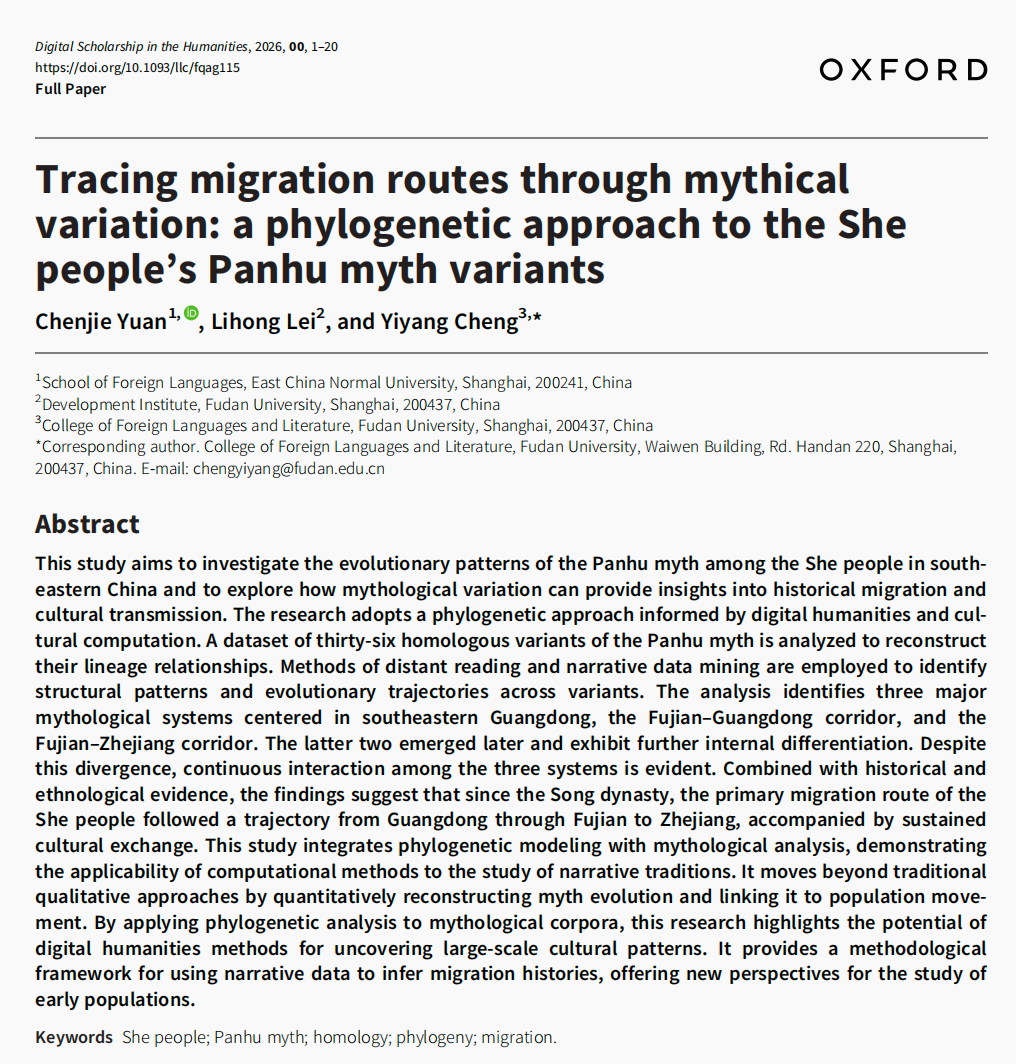
近日,由华东师范大学袁陈杰、复旦大学发展研究院雷李洪、复旦大学外国语言文学学院程弋洋合作完成的论文“Tracing Migration Routes through Mythical Variation: A Phylogenetic Approach to the She People’s Panhu Myth Variants”发表于牛津大学出版社期刊Digital Scholarship in the Humanities。该刊被SSCI和AHCI收录,由牛津大学出版社出版,并与欧洲数字人文协会(EADH)、数字人文组织联盟(ADHO)合作,是数字人文领域历史最悠久的专业期刊之一。
论文以中国东南地区流传的36篇畲族盘瓠神话同源文本为研究对象,引入数字人文领域的文学系统发生分析,通过母题分析、远读和数据挖掘等方法重建神话文本的流变谱系。研究发现,畲族盘瓠神话形成了以粤东、闽粤走廊和闽浙走廊为中心的三个主要体系,三者之间存在明显的传承关系。据此,论文进一步提出,唐宋以来畲族迁徙的主要路径呈现出由粤东经福建向浙江迁移,即“由粤经闽入浙”的大趋势,同时不同地区的畲族群体之间始终存在持续的文化交流。
该研究突破了以往主要依赖史书、方志和谱牒研究族群迁徙的资料路径,将神话文本内部相对稳定的叙事结构作为历史信息加以分析,以量化方式将神话流变与族群迁徙联系起来。研究为畲族唐宋以后由广东向福建、浙江迁徙提供了新的神话学证据,也展示了文学系统发生分析等数字人文方法在人类学、民族学和历史研究中的应用潜力,为利用神话和民间叙事材料研究族群迁徙与文化传播提供了新的方法路径。
作者/Authors
Chenjie Yuan¹, Lihong Lei², Yiyang Cheng³*
¹ School of Foreign Languages, East China Normal University, Shanghai 200241, China
² Development Institute, Fudan University, Shanghai 200437, China
³ College of Foreign Languages and Literature, Fudan University, Shanghai 200437, China
* Corresponding author: Yiyang Cheng, College of Foreign Languages and Literature, Fudan University, Waiwen Building, 220 Handan Road, Shanghai 200437, China. E-mail: chengyiyang@fudan.edu.cn
摘要/Abstract
This study aims to investigate the evolutionary patterns of the Panhu myth among the She people in southeastern China and to explore how mythological variation can provide insights into historical migration and cultural transmission. The research adopts a phylogenetic approach informed by digital humanities and cultural computation. A dataset of thirty-six homologous variants of the Panhu myth is analyzed to reconstruct their lineage relationships. Methods of distant reading and narrative data mining are employed to identify structural patterns and evolutionary trajectories across variants. The analysis identifies three major mythological systems centered in southeastern Guangdong, the Fujian–Guangdong corridor, and the Fujian–Zhejiang corridor. The latter two emerged later and exhibit further internal differentiation. Despite this divergence, continuous interaction among the three systems is evident. Combined with historical and ethnological evidence, the findings suggest that since the Song dynasty, the primary migration route of the She people followed a trajectory from Guangdong through Fujian to Zhejiang, accompanied by sustained cultural exchange. This study integrates phylogenetic modeling with mythological analysis, demonstrating the applicability of computational methods to the study of narrative traditions. It moves beyond traditional qualitative approaches by quantitatively reconstructing myth evolution and linking it to population movement. By applying phylogenetic analysis to mythological corpora, this research highlights the potential of digital humanities methods for uncovering large-scale cultural patterns. It provides a methodological framework for using narrative data to infer migration histories, offering new perspectives for the study of early populations.
关键词/Keywords
She people; Panhu myth; homology; phylogeny; migration.
全文链接/Link

地址:上海市邯郸路220号智库楼
邮编:200433
电话:86-21-55670203
传真:86-21-55670203
电子邮箱:fdifudan@fudan.edu.cn
CopyRight©2007 复旦发展研究院版权所有 备案号/经营许可号:沪ICP备05006147号