作者:江天骄、Shawn Rostker 发布时间:2026-09-27 来源:Survival+收藏本文
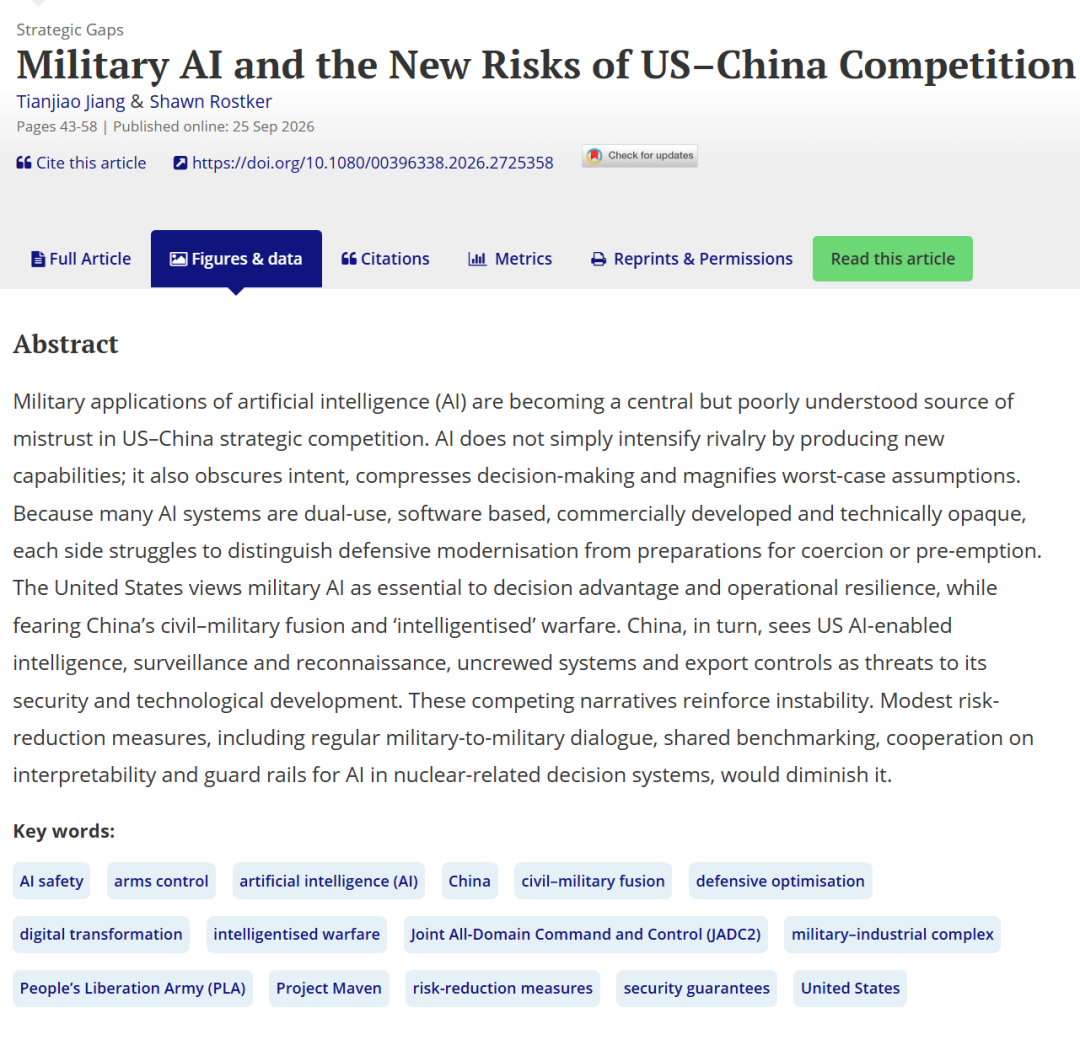
江天骄、Shawn Rostker:《军用AI与中美竞争的新风险》(Military AI and the New Risks of US–China Competition),载国际知名政策类SSCI期刊Survival。
Author:
Tianjiao Jiang
Tianjiao Jiang is an associate professor at the Development Institute of Fudan University, deputy director of the Center for BRICS Studies and research fellow of the Center for Global AI Innovative Governance at Fudan.
Shawn Rostker
Shawn Rostker is a research analyst at the Center for Arms Control and Non-Proliferation.
Abstract:人工智能(AI)的军事应用正成为美中战略竞争中一个核心却未被充分理解的不信任来源。AI并非仅仅通过产生新能力来加剧对抗;它还模糊意图、压缩决策过程,并放大最坏情况假设。由于许多AI系统具有军民两用性、基于软件、由商业开发且技术不透明,双方都难以区分防御性现代化与为胁迫或先发制人所作的准备。美国认为军事AI对决策优势和作战韧性至关重要,同时担忧中国的军民融合与“智能化”战争。中国则反过来将美国由AI赋能的情报、监视与侦察、无人系统及出口管制视为对其安全和技术发展的威胁。这些相互竞争的叙事强化了不稳定。适度的降低风险措施,包括定期军方对军方对话、共享基准测试、可解释性合作,以及为核相关决策系统中的AI设置护栏,将削弱这种不稳定。
Military applications of artificial intelligence (AI) are becoming a central but poorly understood source of mistrust in US–China strategic competition. AI does not simply intensify rivalry by producing new capabilities; it also obscures intent, compresses decision-making and magnifies worst-case assumptions. Because many AI systems are dual-use, software based, commercially developed and technically opaque, each side struggles to distinguish defensive modernisation from preparations for coercion or pre-emption. The United States views military AI as essential to decision advantage and operational resilience, while fearing China’s civil–military fusion and ‘intelligentised’ warfare. China, in turn, sees US AI-enabled intelligence, surveillance and reconnaissance, uncrewed systems and export controls as threats to its security and technological development. These competing narratives reinforce instability. Modest risk-reduction measures, including regular military-to-military dialogue, shared benchmarking, cooperation on interpretability and guard rails for AI in nuclear-related decision systems, would diminish it.
Key words:Al safety; China; arms control; artificial intelligence (Al); civil-military fusion; defensive optimisation; digital transformation; intelligentised warfare; military-industrial complex; Joint All-Domain Command and Control (ADC2); Project Maven; People's Liberation Army (PLA); risk-reduction measures; security guarantees; United States
全文链接:https://www.tandfonline.com/doi/full/10.1080/00396338.2026.2725358

地址:上海市邯郸路220号智库楼
邮编:200433
电话:86-21-55670203
传真:86-21-55670203
电子邮箱:fdifudan@fudan.edu.cn
CopyRight©2007 复旦发展研究院版权所有 备案号/经营许可号:沪ICP备05006147号