作者:Tianjiao Jiang,Tingyi Wang 发布时间:2026-11-15 来源:Anwar Gargash Diplomatic Academy (AGDA)+收藏本文
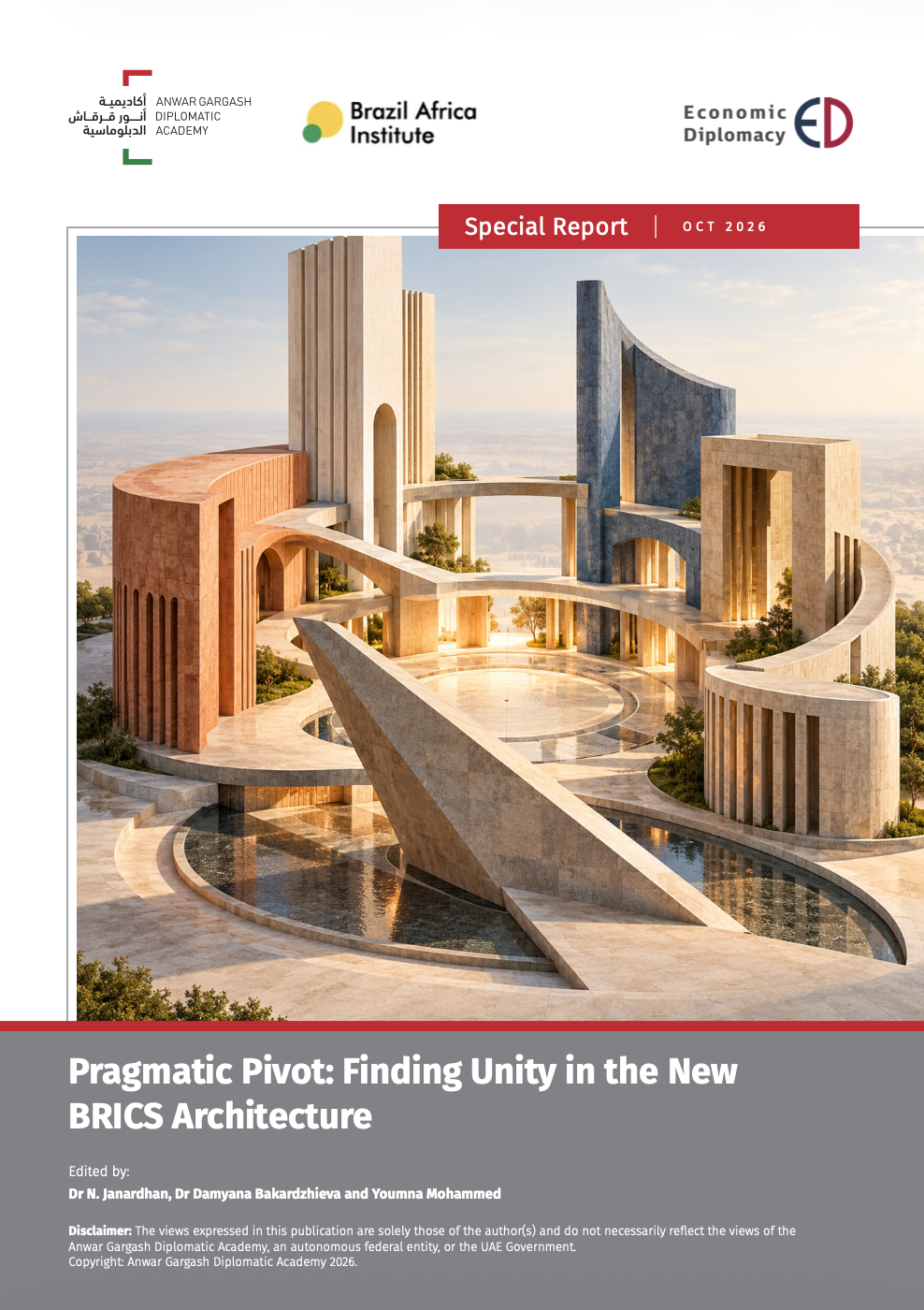
江天骄,王霆懿:《金砖国家人工智能合作:在碎片化的全球秩序中构建数字主权》(AI Cooperation in BRICS: Building Digital Sovereignty in a Fragmented Global Order)载由阿联酋安瓦尔·加尔加什外交学院(AGDA)联合巴西非洲研究所共同推出的专题报告《务实转向:在新的金砖国家架构中寻求团结》(Pragmatic Pivot: Finding Unity in the New BRICS Architecture)。
Authors

Dr Tianjiao Jiang
Associate Professor, Development Institute, Fudan University, China

Dr Tingyi Wang
Research Fellow, Anwar Gargash Diplomatic Academy, United Arab Emirates
Artificial Intelligence (AI), the defining technology of the Fourth Industrial Revolution, is reshaping the global economy, industrial production and governance systems at an unprecedented pace. For BRICS – a grouping representing nearly half of the world’s population and more than one-third of global GDP – AI is far more than a technological breakthrough. It has become a strategic asset that will determine whether emerging economies can achieve technological sovereignty, move up global value chains and gain greater influence in shaping the rules of the digital age. In this sense, AI presents BRICS countries with a historic opportunity to accelerate modernization and strengthen their collective role in global governance.
Yet this opportunity is unfolding against a backdrop of growing technological inequality. The global AI landscape remains highly concentrated, with a handful of advanced economies and technology firms controlling critical resources, including advanced semiconductors, computing power, foundational models, and data. The emergence of a winner-takes-all ecosystem risks widening the digital divide and further marginalising developing countries. For many nations in the Global South, dependence on foreign AI infrastructure and platforms may create a new form of technological dependency.
Against this backdrop, AI cooperation among BRICS countries is no longer merely desirable – it is becoming a strategic necessity. By pooling resources, coordinating investments and jointly developing digital infrastructure, BRICS members can build a more inclusive and diversified AI ecosystem while enhancing their collective digital sovereignty.
Emerging AI Infrastructure Across BRICS
China has significantly lowered barriers to AI adoption across the developing world through its strategy of promoting low-cost, high-performance open-source AI models. This commitment to inclusive and accessible AI development is essential for strengthening BRICS cooperation. Simultaneously, BRICS members are expanding investments in computing infrastructure and AI ecosystems. China has established eight national computing hubs and ten major data centre clusters through its ‘Eastern Data, Western Computing’ initiative. By June 2025, China’s total intelligent computing capacity had reached 788 EFLOPS.
India approved the IndiaAI Mission in 2024 with a budget of approximately US$1.2 billion over five years. The initiative aims to deploy 38,000 GPUs and build a comprehensive national AI ecosystem.
Russia continues to expand its supercomputing capacity through the Sber Christofari and Christofari Neo systems and has adopted a national roadmap for high-performance computing and supercomputer infrastructure development.
Brazil’s 2024 National Artificial Intelligence Plan (PBIA) prioritises AI sovereignty and infrastructure development. In July 2025, Brazil upgraded the Santos Dumont supercomputer at the National Laboratory for Scientific Computing (LNCC), increasing its computing capacity fourfold through new hardware investments.
South Africa released its National Artificial Intelligence Policy Framework Draft in April 2026, explicitly proposing the development of national AI computing infrastructure. Microsoft has simultaneously announced a US$329 million investment to expand AI and data centre capabilities in the country.
The United Arab Emirates has emerged as a major global AI hub. In 2025, G42, in partnership with US technology firms, launched a 5GW AI data centre campus in Abu Dhabi covering approximately ten square miles. The project is positioned as the largest AI infrastructure cluster outside the United States.
However, despite these substantial investments, AI infrastructure development among BRICS members remains largely fragmented and has yet to generate meaningful synergy within the BRICS framework.
Need for Collective Action
Apart from the joint declaration on AI governance issued at the 2025 BRICS Summit in Brazil, practical cooperation on AI within the BRICS framework remains limited.
One notable initiative is the US$5 billion Digital Sovereignty Fund launched by the New Development Bank (NDB) in 2025. The fund represents the largest and most explicit BRICS-wide financing mechanism dedicated to AIrelated infrastructure. Planned investments include AI industrial parks, data centres, semiconductor manufacturing facilities, and computing subsidies for small and medium-sized enterprises.
At the same time, BRICS countries have proposed the concept of a ‘BRICS Digital Cloud Corridor’ aimed at establishing shared data storage facilities and interconnected high-performance computing networks. However, significant technical, regulatory and governance challenges need to be addressed before the initiative can be fully operationalised.
AI development depends not only on computing power but also on access to high-quality data. In this regard, BRICS countries have already established a valuable foundation.
In August 2021, BRICS members signed an agreement on remote-sensing satellite data sharing and created a ‘Virtual Constellation of Remote Sensing Satellites.’ The network includes China’s Gaofen-6 and Ziyuan-3-02 satellites, the jointly developed China-Brazil Earth Resources Satellite (CBERS-04), Russia’s Kanopus-V satellites, and India’s Resourcesat-2 and Resourcesat-2A satellites.
Through data-sharing mechanisms, these satellite systems provide valuable datasets for AI training and applications, enabling BRICS countries to cooperate more effectively in addressing climate change, disaster management, environmental protection, and food security.
China further announced the establishment of the China-BRICS AI Development and Cooperation Center during the Kazan Summit. Located in Shanghai’s Model Speed Space innovation hub, the centre serves as a platform for information sharing, technology collaboration, industrial applications of large language models, AI talent development, and international AI standard-setting. In May 2025, the centre established an achievement – transformation office in Brazil to facilitate the expansion of Chinese AI enterprises into Latin American markets. It is also promoting cooperation on emerging infrastructure, including AI-enabled 5G integration networks.
Policy Recommendations
Artificial intelligence is no longer merely an additional area of cooperation for BRICS; it is emerging as a strategic pillar that will shape the bloc’s competitiveness, cohesion and global influence in the coming decade. As AI increasingly becomes the foundation of economic growth, industrial transformation and technological sovereignty, BRICS countries must move beyond fragmented national initiatives and pursue deeper institutionalised cooperation. Through collaborative innovation, shared infrastructure and coordinated rulemaking, BRICS can not only accelerate its members’ modernisation agendas but also contribute to building a more equitable and inclusive digital order for the Global South.
Establish a BRICS Computing Power Network
Computing power is the backbone of AI development. Yet computing resources remain unevenly distributed across BRICS countries, and many members continue to rely heavily on Western commercial cloud providers and digital infrastructure. To address this imbalance, BRICS should establish a BRICS Computing Power Network that enables the sharing and allocation of computing resources across member states. Idle computing capacity could be tokenised and made available on demand to countries facing shortages, thereby improving efficiency and reducing barriers to AI development. At the same time, member states should jointly invest in large-scale green data centres located in strategically selected digital hubs and operating under common BRICS cybersecurity and data protection standards. Such a network would significantly reduce AI training and storage costs, strengthen digital sovereignty and enhance the resilience of BRICS’ technological ecosystems.
Build a BRICS Multilingual AI Corpus and Data-Sharing Framework
Today’s leading large language models are overwhelmingly trained on English language datasets, creating risks of cultural bias and the marginalization of many BRICS languages, including Portuguese, Hindi, Russian, Arabic, and numerous Chinese dialects. If left unaddressed, the AI revolution may further reinforce existing linguistic and cultural hierarchies in the digital sphere.
BRICS countries should therefore jointly develop a BRICS Multilingual High-Quality Corpus that reflects the linguistic, cultural and social diversity of the Global South. Such a corpus would not only improve the performance of AI systems in local contexts but also preserve linguistic heritage in the digital age. Simultaneously, member states should accelerate negotiations on cross-border data governance and establish trusted mechanisms for sharing public sector datasets for AI training, scientific research and public service innovation. Enhanced data cooperation would strengthen AI capabilities while improving governance coordination across the bloc.
Create a BRICS AI Talent Mobility and Innovation Framework
While BRICS countries collectively produce a large pool of highly qualified engineers, researchers and AI specialists, many continue to migrate to developed economies, resulting in a persistent talent drain.
To address this challenge, BRICS should establish a mutual recognition framework for AI-related professional qualifications and jointly develop certification standards covering areas such as AI ethics, algorithm engineering, machine learning, data annotation, and digital governance. Certified professionals should enjoy streamlined mobility and recognition of credentials across member states.
In addition, BRICS should launch dedicated fellowship and exchange programs that enable leading AI researchers, engineers and entrepreneurs to rotate among universities, research institutions and technology companies across the bloc. Joint degree programs, shared AI curricula and credit transfer mechanisms should also be developed to cultivate the next generation of AI talent. By fostering a more integrated innovation ecosystem, BRICS can transform its demographic and educational advantages into long-term technological leadership.
Conclusion
The future relevance and influence of BRICS will depend, to a significant extent, on its capacity to shape the trajectory of the AI revolution. Through coordinated investments in computing infrastructure, multilingual AI development and talent mobility, BRICS can transform isolated national efforts into a shared innovation ecosystem. In doing so, the bloc would not only strengthen its collective technological resilience and digital sovereignty, but also contribute to the emergence of a more balanced and inclusive global digital order, ensuring that the Global South plays a meaningful role in defining the rules and norms of the AI age.

地址:上海市邯郸路220号智库楼
邮编:200433
电话:86-21-55670203
传真:86-21-55670203
电子邮箱:fdifudan@fudan.edu.cn
CopyRight©2007 复旦发展研究院版权所有 备案号/经营许可号:沪ICP备05006147号