作者:王帆 程旻娜等 发布时间:2026-04-11 来源:Diabetology & Metabolic Syndrome+收藏本文
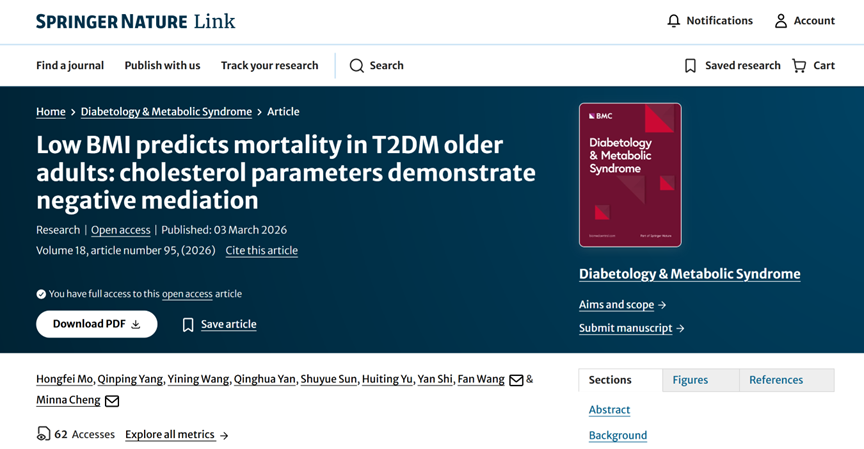
近日,由我院王帆教授(共同通讯作者)、公共卫生学院博士研究生莫鸿飞(共同第一作者),以及上海市疾病预防控制中心程旻娜主任(共同通讯作者)、杨沁平医师(共同第一作者)等专家合作完成的论文“Low BMI predicts mortality in T2DM older adults: cholesterol parameters demonstrate negative mediation”发表于期刊《Diabetology & Metabolic Syndrome》(JCR Q2)。该期刊是糖尿病与内分泌代谢领域专业期刊,聚焦糖尿病及其并发症的流行病学、临床管理及基础研究,涵盖脂代谢、肥胖与慢性病预后等方向。本研究成果体现了王帆教授团队在社区糖尿病管理及体重相关代谢异常方面的积极探索。
本研究基于上海市糖尿病管理队列中372,559名老年2型糖尿病(T2DM)患者,系统探讨了低身体质量指数(BMI<22 kg/m²)与全因死亡风险的关联,并量化了总胆固醇(TC)、高密度脂蛋白胆固醇(HDL-C)、低密度脂蛋白胆固醇(LDL-C)在该关联中的中介作用。研究发现,低BMI显著增加老年T2DM患者的全因死亡风险(HR=1.10);TC和LDL-C与死亡风险呈U型非线性关系,HDL-C呈L型关系,最佳阈值分别为5.03 mmol/L、0.98 mmol/L和3.39 mmol/L。更重要的是,TC、HDL-C、LDL-C均呈现负向中介作用(即“遮掩效应”),其中HDL-C的负向中介效应最强(中介比例为‑111.99%),提示低BMI相关的HDL-C下降可能部分解释了低BMI与死亡风险之间的关联。该成果首次揭示了胆固醇参数在老年T2DM患者低BMI与死亡风险关联中的复杂间接作用,尤其是HDL-C的核心遮掩角色,为临床实践中关注低体重老年糖尿病患者的血脂代谢紊乱(特别是HDL-C偏低)提供了新的科学依据,对优化个体化体重与血脂管理策略具有重要临床与公共卫生意义。
作者/Authors
Hongfei Mo1,2†, Qinping Yang3†, Yining Wang2, Qinghua Yan3, Shuyue Sun1,2, Huiting Yu4, Yan Shi3, Fan Wang1* and Minna Cheng3*
1Fudan Development Institute, Fudan University, Shanghai, People's Republic of China
2School of Public Health, Fudan University, Shanghai, People's Republic of China
3Institute for Chronic Non-Communicable Diseases Control, Shanghai Municipal Center for Disease Control and Prevention, Shanghai, People's Republic of China
4Department of Vital Statistics, Shanghai Municipal Center for Disease Control and Prevention, Shanghai, People's Republic of China
†Hongfei Mo and Qinping Yang contributed equally
*Correspondence to Fan Wang and Minna Cheng
摘要/Abstract
目的 本研究旨在探讨低身体质量指数(BMI<22 kg/m²)及核心血脂指标与老年2型糖尿病(T2DM)患者全因死亡风险的关联,并评估总胆固醇(TC)、甘油三酯(TG)、高密度脂蛋白胆固醇(HDL-C)和低密度脂蛋白胆固醇(LDL-C)在其中的中介作用。
方法 研究数据来源于上海市疾病预防控制中心(SCDC)糖尿病管理队列,共纳入372,559名年龄≥60岁的T2DM患者,按BMI<22 kg/m²进行分层分析。采用线性回归分析低BMI与血脂指标的关联,采用Cox回归评估低BMI及血脂指标与死亡风险的关系。使用限制性立方样条(RCS)模型评估非线性趋势,并采用贝叶斯中介模型量化中介效应。
结果 与低BMI组相比,非低BMI组的全因死亡风险显著更高(HR = 1.10,95% CI:1.06~1.13)。在血脂指标中,TC、HDL-C和LDL‑C与死亡风险呈非线性关联(TC和LDL-C呈U型,HDL-C呈L型),其最佳阈值分别为5.03 mmol/L、0.98 mmol/L和3.39 mmol/L。中介分析显示,TC(中介比例PE = -16.68%)、HDL-C(PE = -111.99%)和LDL-C(PE = -4.12%)均表现出显著的负向中介作用,其中HDL-C的遮掩效应最强(βACME = 1.44,95% CI:1.33~1.56)。
结论 低BMI与老年T2DM患者死亡风险增加独立相关。胆固醇指标,尤其是HDL-C,可能通过负向中介作用部分解释这一关联。该发现提示临床应更多关注低体重老年T2DM患者的脂代谢紊乱问题。
Objective The present study aims to investigate the association of low body mass index (BMI < 22 kg/m2) and core lipid parameters on all-cause mortality among older adults with type 2 diabetes mellitus (T2DM), and to assess the mediating roles of total cholesterol (TC), triglycerides (TG), high-density lipoprotein cholesterol (HDL-C), and low-density lipoprotein cholesterol (LDL-C).
Methods Data were analyzed from 372,559 T2DM participants aged ≥ 60 years, obtained from the Shanghai Center for Disease Control and Prevention (SCDC) diabetes management cohort, stratified by BMI < 22 kg/m2. Associations between low BMI and lipid parameters were examined using linear regression, associations of low BMI and lipid parameters with mortality risk were assessed via Cox regression. Restricted cubic spline (RCS) models were used to evaluate nonlinear trends, and Bayesian mediation models quantified the mediating effects.
Results The low BMI group had a significantly higher risk of all-cause mortality compared to the non-low BMI group (HR = 1.10, 95% CI: 1.06 ~ 1.13). Among the lipid parameters, TC, HDL-C, and LDL-C were nonlinearly associated with mortality risk (U-shaped for TC and LDL-C, L-shaped for HDL-C), with optimal thresholds identified at 5.03 mmol/L, 0.98 mmol/L, and 3.39 mmol/L, respectively. Mediation analysis demonstrated significant negative mediation for TC (proportion mediated, PE = –16.68%), HDL-C (PE = –111.99%), and LDL-C (PE = –4.12%), with HDL-C showing the strongest masking effect (βACME = 1.44, 95% CI: 1.33 ~ 1.56).
Conclusion Low BMI is independently associated with an increased risk of mortality in T2DM older adults. Cholesterol parameters, particularly HDL-C, may explain part of this association through negative mediation. These findings suggest the need for clinical attention to lipid metabolic disturbances among underweight older adults.
关键词/Key Words
全因死亡率;胆固醇;低身体质量指数;脂质参数;中介分析;老年人;2型糖尿病
All-cause mortality, Cholesterol, Low BMI, Lipid parameters, Mediation analysis, Older adults, Type 2 diabetes mellitus (T2DM)
全文链接/Link
https://link.springer.com/article/10.1186/s13098-026-02118-y

地址:上海市邯郸路220号智库楼
邮编:200433
电话:86-21-55670203
传真:86-21-55670203
电子邮箱:fdifudan@fudan.edu.cn
CopyRight©2007 复旦发展研究院版权所有 备案号/经营许可号:沪ICP备05006147号