作者: 发布时间:2026-06-22 来源:复旦发展研究院+收藏本文
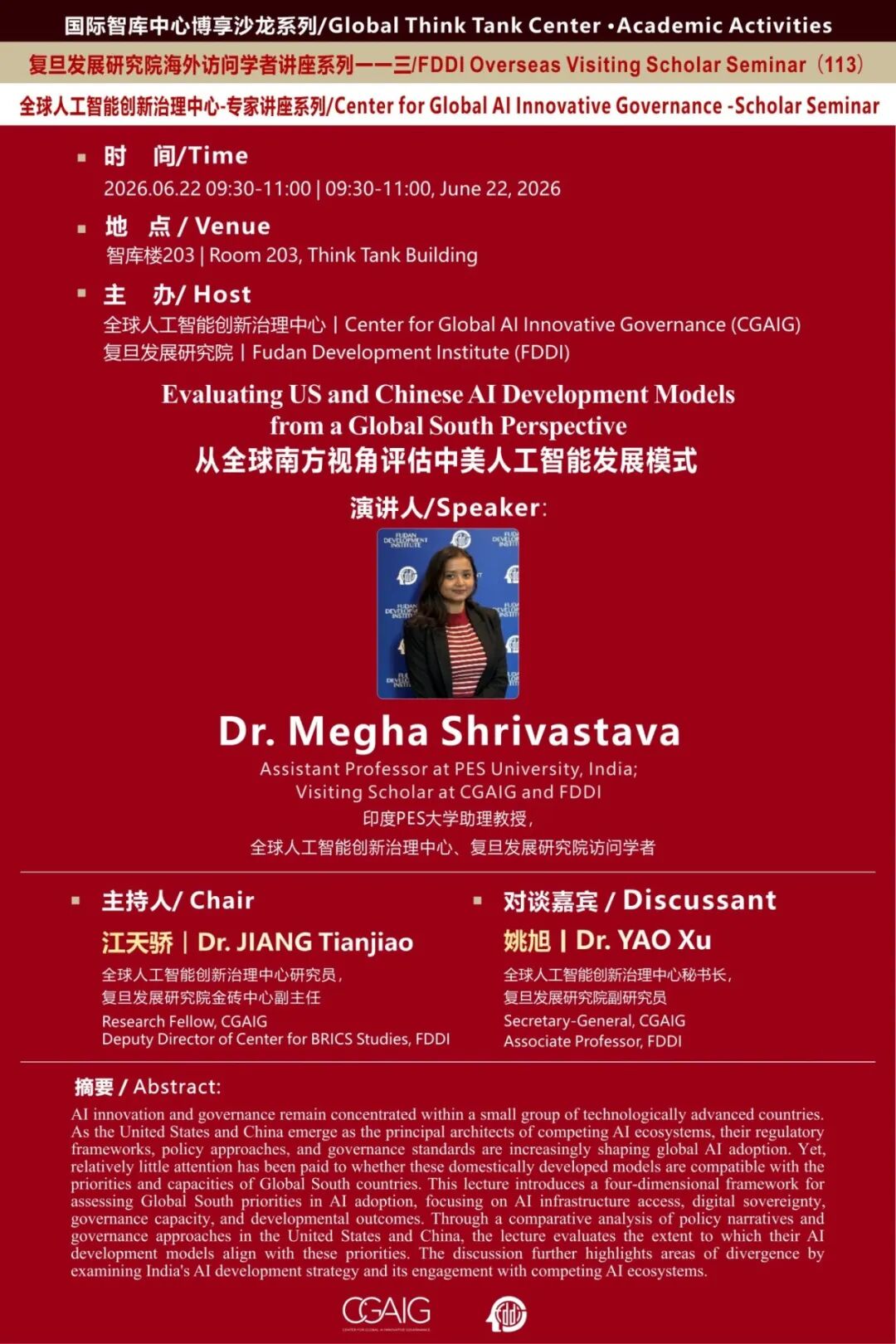
国际智库中心博享沙龙系列
Global Think Tank Center Academic Activities
复旦发展研究院海外访问学者讲座系列113
FDDI Overseas Visiting Scholar Seminar (113)
全球人工智能创新治理中心-专家讲座系列
Center for Global AI Innovative Governance Scholar Seminar
从全球南方视角评估中美人工智能发展模式
Evaluating US and Chinese AI Development Models
from a Global South Perspective
2026.06.22 09:30-11:00
09:30-11:00, June 22, 2026
智库楼203
Room 203, Think Tank Building
全球人工智能创新治理中心
Center for Global AI Innovative Governance (CGAIG)
复旦发展研究院
Fudan Development Institute (FDDI)
Dr. Megha Shrivastava
Assistant Professor at PES University, India;
Visiting Scholar at CGAIG and FDDI
印度PES大学助理教授
全球人工智能创新治理中心、
复旦发展研究院访问学者
江天骄
Dr. JIANG Tianjiao
全球人工智能创新治理中心研究员
复旦发展研究院金砖中心副主任
Research Fellow, CGAIG
Deputy Director of Center for BRICS Studies, FDDI
姚旭
Dr. YAO Xu
全球人工智能创新治理中心秘书长
复旦发展研究院副研究员
Secretary-General, CGAIG
Associate Professor, FDDI
AI innovation and governance remain concentrated within a small group of technologically advanced countries. As the United States and China emerge as the principal architects of competing AI ecosystems, their regulatory frameworks, policy approaches, and governance standards are increasingly shaping global AI adoption. Yet, relatively little attention has been paid to whether these domestically developed models are compatible with the priorities and capacities of Global South countries. This lecture introduces a four-dimensional framework for assessing Global South priorities in AI adoption, focusing on AI infrastructure access, digital sovereignty, governance capacity, and developmental outcomes. Through a comparative analysis of policy narratives and governance approaches in the United States and China, the lecture evaluates the extent to which their AI development models align with these priorities. The discussion further highlights areas of divergence by examining India's AI development strategy and its engagement with competing AI ecosystems.

地址:上海市邯郸路220号智库楼
邮编:200433
电话:86-21-55670203
传真:86-21-55670203
电子邮箱:fdifudan@fudan.edu.cn
CopyRight©2007 复旦发展研究院版权所有 备案号/经营许可号:沪ICP备05006147号